

Writing is one of the most valuable communication skills a person can develop. Whether you are a student, professional, blogger, business owner, content creator, or aspiring author, strong writing skills help you communicate ideas clearly and confidently. Good writing is not simply about using difficult words or following grammar rules. It involves understanding your audience, organizing information, choosing the right tone, developing ideas, and making every sentence easy to understand.
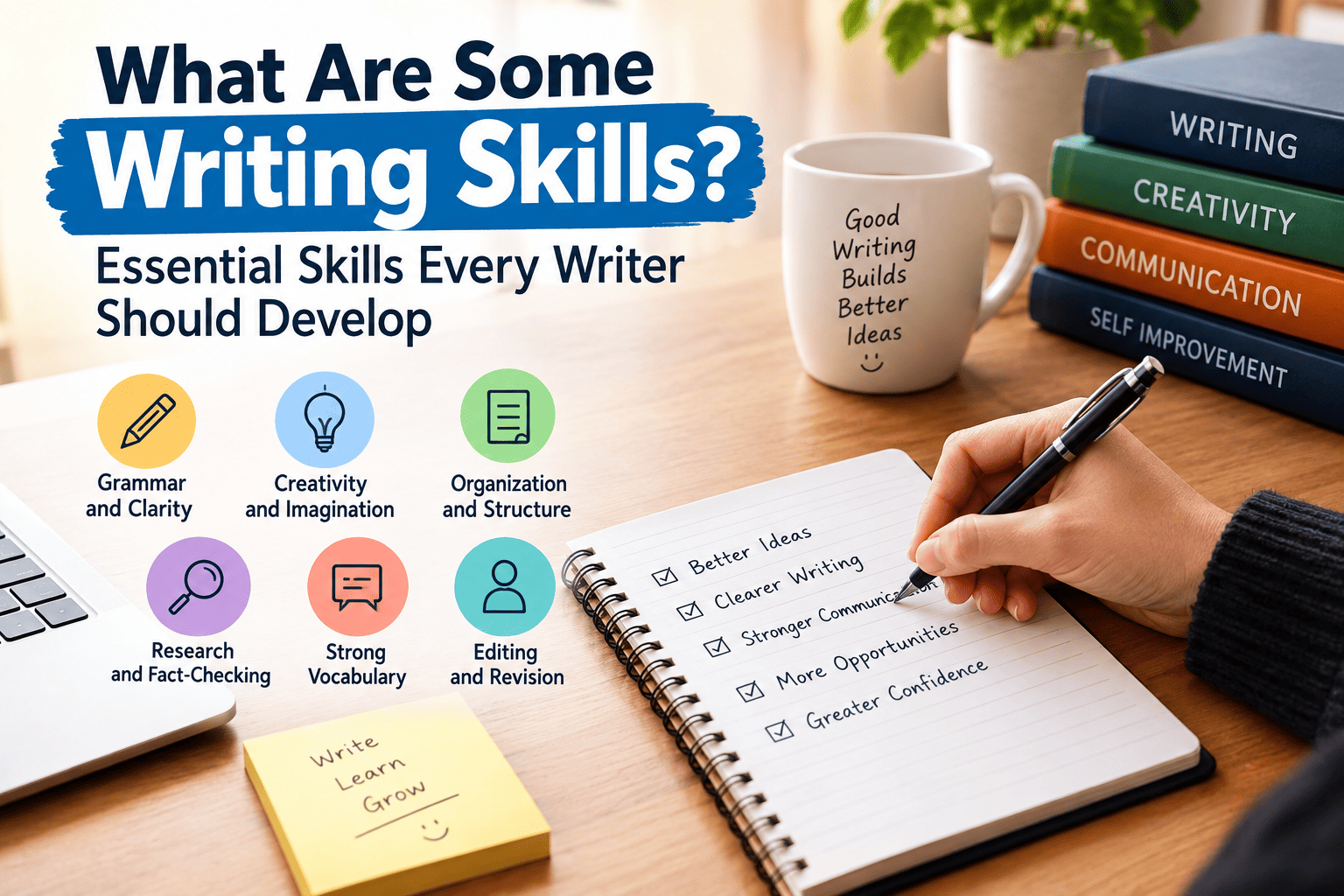
If you are wondering, what are some writing skills that every writer should develop, there are several important abilities to focus on. These include grammar, sentence structure, clarity, organization, research, vocabulary, editing, storytelling, audience awareness, and adaptability. Developing these skills takes practice, but even small improvements can make your writing more effective.
What Are Some Writing Skills?
Writing skills are the abilities that allow you to express thoughts, information, opinions, and ideas effectively through written language. They cover everything from creating a strong introduction to organizing paragraphs and correcting mistakes before publishing.
Some of the most important writing skills include:
- Grammar and punctuation
- Clear and concise writing
- Strong sentence structure
- Organization and paragraph development
- Research skills
- Vocabulary and word choice
- Editing and proofreading
- Audience awareness
- Creative and critical thinking
- Storytelling
- Adaptability and tone
- Writing consistency
These skills work together. A writer may have an excellent vocabulary, for example, but if the ideas are poorly organized, the overall piece can still be difficult to read.
1. Grammar and Punctuation
Grammar is one of the foundations of effective writing. It helps readers understand how words and sentences relate to one another. Correct grammar makes your writing easier to follow and gives your work a more professional appearance.
Punctuation is equally important because marks such as commas, periods, colons, and quotation marks help control the meaning and rhythm of sentences. A small punctuation mistake can sometimes change the meaning of an entire sentence.
However, becoming a good writer does not mean trying to make every sentence complicated. Strong writing usually combines correct grammar with simple and natural language. Learning common grammar rules and reviewing your mistakes regularly can gradually improve your accuracy.
2. Clarity and Conciseness
One of the most valuable writing abilities is explaining an idea clearly. Readers should not have to struggle to understand what you are trying to say.
Clear writing uses straightforward language, logical sentences, and relevant information. Concise writing avoids unnecessary repetition and removes words that do not contribute meaningful information.
For example, instead of using a long sentence to communicate a simple idea, a writer can often make the same point with fewer words. This is especially important for websites, business communication, educational content, emails, and online articles where readers often want information quickly.
3. Strong Sentence Structure
Sentence structure affects how smoothly an article or document reads. Effective writers know how to combine short, medium, and longer sentences to create a natural rhythm.
Using only short sentences can make writing feel repetitive. On the other hand, using extremely long sentences can make complex ideas difficult to understand. A good writer learns to vary sentence length while keeping each sentence focused on one main idea.
Strong sentence structure also means placing information in a logical order. The beginning of a sentence should establish the subject or main point, while the rest should provide useful information, explanation, or context.
4. Organization and Paragraph Development
Good ideas become much more powerful when they are organized properly. Before starting a longer article, it helps to understand what you want the reader to learn and how each section will contribute to that goal.
A well-organized article normally has an introduction, clearly defined sections, supporting explanations, and a conclusion. Each paragraph should have a purpose rather than simply adding words to the page.
A strong paragraph generally introduces one central idea and then develops it with explanation, examples, evidence, or context. This makes the content easier to scan and helps readers understand how different points connect.
5. Research Skills
Research is an essential writing skill, particularly when creating educational, professional, technical, or informational content. Good research helps writers understand a subject before presenting it to readers.
Effective research involves finding reliable information, comparing sources, identifying relevant facts, and separating evidence from assumptions. Writers should avoid depending entirely on one source when a topic requires detailed or factual coverage.
Research also helps writers discover questions that readers commonly have. Understanding those questions can lead to more useful articles because the content is built around real information needs rather than vague general statements.
6. Vocabulary and Word Choice
A strong vocabulary gives writers more ways to express ideas accurately. However, effective writing does not mean using complicated words whenever possible.
The best word is usually the one that communicates the intended meaning clearly. Simple vocabulary can be extremely powerful when it is precise and appropriate for the audience.
Writers should also pay attention to repetition. Using the same word in every sentence can make content feel monotonous. Developing vocabulary allows writers to choose alternatives while maintaining the exact meaning and tone they want.
7. Editing and Proofreading
Writing the first draft is only part of the process. Editing allows writers to improve the structure, clarity, accuracy, and overall quality of their work.
During editing, look for unnecessary sentences, repeated ideas, weak transitions, unclear explanations, and sections that need additional information. Proofreading should then focus on smaller issues such as spelling, punctuation, capitalization, and grammatical errors.
Reading your work slowly after taking a short break can reveal mistakes that were easy to overlook during the initial writing process. Reading the text aloud can also help identify awkward sentences and unnatural phrasing.
8. Understanding Your Audience
Great writing begins with understanding who will read it. The language and structure that work for a university essay may not work for a beginner-friendly blog post or a business email.
Before writing, consider the reader’s knowledge level, expectations, interests, and reason for reading. If the audience is unfamiliar with a subject, explain important terms before introducing advanced concepts.
Audience awareness also influences tone. A professional report may require formal language, while a casual blog can use a more conversational style. Choosing the right approach makes content more relevant and engaging.
9. Storytelling Skills
Storytelling is not limited to novels and fiction. It can make many types of writing more interesting, including marketing content, personal essays, biographies, presentations, and educational articles.
A good story gives information context and creates a connection with the reader. It can introduce a problem, explain an experience, present a challenge, or show how a situation changed over time.
Even when writing factual content, small examples and real-world scenarios can make complicated ideas easier to understand. This is why storytelling remains an important skill for both creative and professional writers.
10. Critical Thinking
Writing and critical thinking are closely connected. Before presenting an idea, a writer should consider whether the information makes sense, whether evidence supports it, and whether there are other perspectives worth mentioning.
Critical thinking helps writers avoid unsupported claims and weak arguments. It also encourages them to ask better questions and identify gaps in their own explanations.
For persuasive writing, this skill becomes particularly important. A strong writer does not simply state an opinion but explains why that opinion is reasonable and supports important claims with appropriate evidence.
11. Adaptability
A successful writer should be able to write for different formats and purposes. Blog posts, emails, reports, social media posts, academic assignments, product descriptions, and stories all require different approaches.
Adaptability means changing your vocabulary, sentence structure, tone, and organization according to the situation. A writer who can adjust their style can communicate effectively with a wider range of readers.
This skill is especially valuable in modern workplaces because many professionals are expected to communicate through multiple written formats every day.
12. Writing With the Right Tone
Tone describes the feeling or attitude communicated through writing. Your tone might be professional, friendly, informative, persuasive, enthusiastic, serious, or conversational.
Choosing the right tone helps readers understand how they should interpret the message. For example, a customer-service response generally needs to sound respectful and helpful, while a personal blog may feel more relaxed.
Strong writers learn how to maintain a consistent tone throughout a piece. Sudden changes in tone can make content feel confusing or poorly edited.
13. Creativity and Originality
Creativity helps writers present familiar subjects in fresh and interesting ways. Originality does not necessarily mean inventing a completely new topic. It can involve finding a different perspective, using a memorable example, or explaining a common idea more effectively.
Creative thinking is particularly useful for headlines, introductions, storytelling, marketing content, fiction, and opinion writing.
At the same time, originality should not come at the expense of accuracy. The goal is to make information engaging while keeping the content useful and trustworthy.
How Can You Improve Your Writing Skills?
Improving writing skills requires regular practice rather than trying to become perfect overnight. One of the simplest approaches is to write consistently. You can keep a journal, write short articles, summarize what you read, or practice explaining complicated subjects in simple language.
Reading high-quality writing is equally useful. Pay attention to how experienced writers begin their articles, transition between ideas, explain unfamiliar concepts, and conclude their discussions.
Another effective method is to revise your own work. After completing a draft, ask yourself whether every paragraph has a purpose, whether the ideas are logically connected, and whether a reader could understand the topic without additional explanation.
A Simple Writing Skills Practice Routine
If you want a practical way to develop your abilities, create a small daily writing routine. Spend a few minutes reading quality content, then write a short passage about a topic you understand.
After writing, review the passage for grammar, clarity, sentence variety, repetition, and organization. Choose one weakness to improve rather than trying to fix everything at once.
Over time, this repeated process can make writing more natural. You will begin to recognize weak sentences, unnecessary words, missing explanations, and awkward transitions more quickly.
Common Writing Mistakes to Avoid
Even experienced writers make mistakes, but recognizing common problems can help you improve faster. One frequent mistake is trying to sound overly sophisticated by using complicated vocabulary. This can make simple ideas unnecessarily difficult.
Another problem is repetition. Repeating the same point in several paragraphs can reduce the value of an article. Writers should also avoid weak introductions that take too long to explain what the reader will learn.
Poor organization is another major issue. Even accurate information can become confusing when ideas appear in an unrelated order. Finally, publishing content without proofreading can leave avoidable grammar and spelling errors that reduce credibility.
Why Are Writing Skills Important?
Writing skills are important because written communication is part of almost every area of modern life. Students use writing for assignments and research. Professionals use it for emails, reports, proposals, presentations, and documentation. Businesses use written content to communicate with customers and promote their products or services.
Strong writing can also improve your ability to think. When you organize an idea into clear sentences and paragraphs, you are forced to understand the subject more carefully.
For these reasons, writing is not just an academic skill. It is a practical communication ability that can support education, careers, business, and everyday interactions.
Frequently Asked Questions
What are some writing skills everyone should learn?
Some of the most useful writing skills include grammar, punctuation, clarity, organization, vocabulary, research, editing, proofreading, audience awareness, storytelling, critical thinking, and adaptability.
What is the most important writing skill?
There is no single skill that is most important in every situation, but clarity is one of the most valuable. Readers should be able to understand your main message without unnecessary effort.
How can beginners improve their writing skills?
Beginners can improve by writing regularly, reading quality material, learning basic grammar, expanding vocabulary, practicing organization, and revising their work before considering it finished.
Why is proofreading important in writing?
Proofreading helps identify spelling, punctuation, grammar, and formatting mistakes. It provides a final quality check and can make written communication appear more professional.
How does reading improve writing?
Reading exposes you to different vocabulary, sentence structures, writing styles, and ways of organizing information. Paying attention to how good writers communicate can give you useful ideas for improving your own writing.
Are writing skills important for a career?
Yes. Many careers require employees to communicate through emails, reports, proposals, documents, presentations, or online content. Strong writing can therefore be useful in almost any professional environment.
Final Thoughts
Understanding what are some writing skills is only the beginning of becoming a better writer. The most effective approach is to develop several abilities together, including grammar, clarity, organization, research, vocabulary, editing, audience awareness, and critical thinking.
You do not need to master every skill immediately. Start by writing regularly, reading carefully, and reviewing your work with a critical eye. With consistent practice, your sentences can become clearer, your ideas more organized, and your writing more engaging.
Ultimately, great writing is about communication. When readers can understand your ideas easily, find the information useful, and stay interested in what you have written, you are already applying the most important principles of effective writing.