

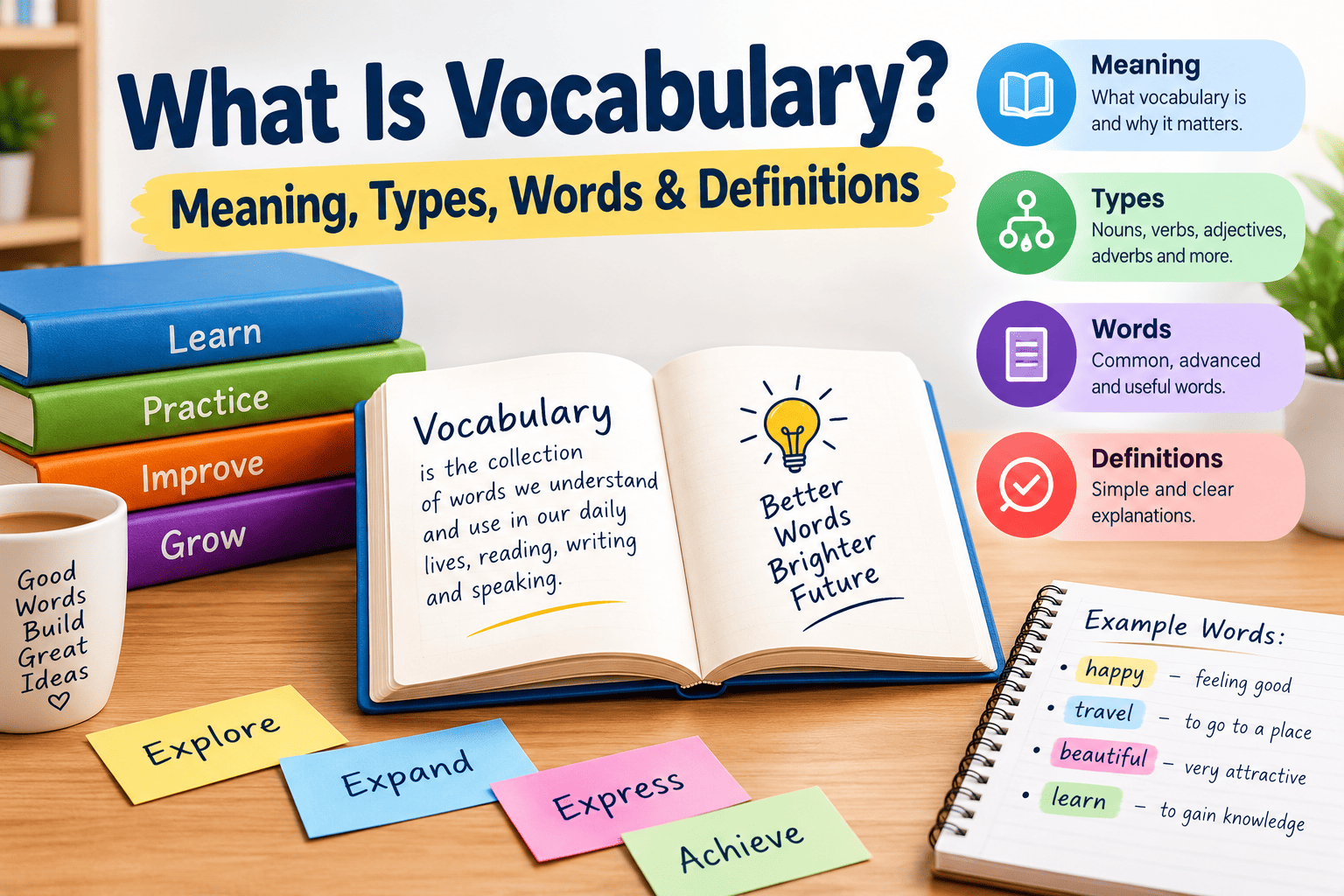
Vocabulary is one of the most important parts of language. It refers to the words a person knows, understands, recognizes, and uses when speaking, writing, reading, or listening. A strong vocabulary makes it easier to express ideas clearly, understand other people, and communicate effectively in everyday, academic, and professional situations.
Whether you are learning English as a new language or improving your existing language skills, understanding vocabulary is an important first step. In this guide, we explain what vocabulary means, what vocabulary words are, the different types of vocabulary, and why building a strong vocabulary matters.
What Is Vocabulary?
Vocabulary is the collection of words that a person knows and uses in a particular language. It can include simple everyday words, academic terms, technical expressions, descriptive words, and more advanced vocabulary.
For example, words such as book, learn, happy, important, communicate, opportunity, and understand are all vocabulary words. The words you understand when reading may be much greater than the number of words you regularly use when speaking or writing.
In simple terms, vocabulary means the words and expressions that make up a person’s knowledge and use of a language.
What Is a Vocabulary Word?
A vocabulary word is a word that is learned, studied, or used as part of someone’s language knowledge. Vocabulary words can range from basic terms to advanced words with more complex meanings.
For example:
- Happy — feeling pleasure or joy
- Rapid — happening very quickly
- Essential — extremely important or necessary
- Accurate — correct or free from mistakes
- Curious — wanting to know or learn something
Learning vocabulary words is not simply about memorizing definitions. A learner should also understand how a word is used in a sentence, what type of word it is, and which words have similar or opposite meanings.
Vocabulary Meaning and Definition
The meaning of a vocabulary word depends on how it is used. Some words can have several meanings, while others have a more specific definition.
For example, the word “bright” can describe something that produces a lot of light, but it can also describe an intelligent person. This is why learning a vocabulary word in context is often more useful than memorizing a single definition.
A good vocabulary-learning approach combines the word, its meaning, pronunciation, examples, and common uses.
What Are Vocabulary Words?
Vocabulary words can be divided into many groups based on their difficulty, purpose, and context. Some are common words used in daily conversations, while others appear more frequently in education, literature, science, business, or professional communication.
Common vocabulary categories include:
Basic Vocabulary
Basic vocabulary includes words used in everyday communication. Examples include:
- family
- food
- house
- school
- friend
- work
- water
- time
These words are usually among the first vocabulary words that language learners study.
Academic Vocabulary
Academic vocabulary includes words commonly used in schools, colleges, textbooks, research, and formal writing. Examples include analyze, evaluate, evidence, theory, method, significant, and conclusion.
Students often need a strong academic vocabulary to understand textbooks and write effectively.
Advanced Vocabulary
Advanced vocabulary includes less common or more sophisticated words. Examples include substantial, inevitable, sophisticated, consequently, demonstrate, and comprehensive.
Advanced vocabulary can help make writing more precise, but difficult words should be used appropriately rather than simply to make writing sound complicated.
Technical Vocabulary
Technical vocabulary consists of specialized terms used in particular subjects or professions. For example, medicine, technology, finance, engineering, and law all have their own vocabulary terms.
Someone studying a specific field may need to learn its technical vocabulary to understand professional information.
Types of Vocabulary
Vocabulary is often discussed in terms of how people encounter and use words. Four common categories are receptive vocabulary, productive vocabulary, listening vocabulary, and reading vocabulary.
Receptive Vocabulary
Receptive vocabulary includes words that a person can understand when reading or listening, even if they do not normally use those words themselves.
For example, you might understand the word “enormous” when someone uses it, but you may normally choose the simpler word “big” when speaking.
Productive Vocabulary
Productive vocabulary includes words that a person can actively use when speaking or writing. A learner’s productive vocabulary is usually smaller than their total receptive vocabulary.
The more a learner practices using new words, the easier it becomes to move words from passive understanding into active vocabulary.
Listening Vocabulary
Listening vocabulary refers to words that a person recognizes and understands when hearing them in conversation, videos, lectures, or other spoken content.
Listening vocabulary is especially important for language learners because pronunciation can sometimes make familiar words difficult to recognize.
Reading Vocabulary
Reading vocabulary includes words that a person understands while reading books, articles, websites, newspapers, and other written material.
Reading regularly is one of the most effective ways to encounter new vocabulary in context.
Why Is Vocabulary Important?
Vocabulary plays an important role in communication and learning. A person may understand grammar rules, but limited vocabulary can still make it difficult to express ideas accurately.
A strong vocabulary can help you:
- communicate ideas more clearly
- understand what you read
- follow conversations more easily
- write with greater accuracy
- perform better in academic settings
- understand unfamiliar subjects
- express emotions and opinions more precisely
Vocabulary is also closely connected with reading comprehension. When you know more words, it becomes easier to understand the overall meaning of a text.
Vocabulary Words With Meaning
One of the most useful ways to learn new vocabulary is to study words together with their meanings and examples.
Here are a few examples:
| Word | Meaning | Example |
| Abundant | Available in large quantities | The region has abundant natural resources. |
| Benevolent | Kind and generous | The benevolent person helped the local community. |
| Concise | Brief but clear | Please give a concise answer. |
| Diligent | Hard-working and careful | She is a diligent student. |
| Essential | Necessary or extremely important | Water is essential for life. |
| Flexible | Able to change or adapt | A flexible schedule can be useful. |
| Significant | Important or meaningful | The discovery was significant. |
Learning words in this format can make it easier to remember their meanings and understand how they work in real sentences.
What Is a Good Vocabulary?
A good vocabulary does not necessarily mean knowing extremely difficult words. Instead, it means having enough words to understand information and communicate ideas accurately and effectively.
For example, knowing when to use “happy,” “pleased,” “delighted,” or “thrilled” demonstrates a useful understanding of vocabulary because these words express different levels or shades of positive emotion.
The goal should be useful vocabulary, not simply a large vocabulary.
How Does Vocabulary Grow?
Vocabulary develops through repeated exposure and active use. Reading books, listening to conversations, watching educational content, writing regularly, and speaking with others can all introduce you to new words.
When you encounter an unfamiliar word, try to understand it from the surrounding sentence before checking a dictionary. Then record the word, its meaning, and an example sentence. Reviewing it later helps strengthen your memory.
A vocabulary list can also be useful. However, instead of creating a list of isolated words, include context, synonyms, antonyms, and example sentences whenever possible.
Vocabulary Word of the Day
A vocabulary word of the day is a simple learning method in which you focus on one new word each day. This approach can work well because it gives learners a manageable goal.
For example, today’s word could be “resilient,” meaning able to recover or adapt after difficulty.
Instead of only memorizing the definition, try using the word in your own sentence. Repeatedly using new vocabulary helps turn passive knowledge into active vocabulary.
Vocabulary and Definitions: Common Mistakes
One common mistake is assuming that memorizing hundreds of definitions automatically creates a strong vocabulary. In reality, knowing a word involves more than knowing its dictionary definition.
Learners should also consider pronunciation, spelling, grammatical form, context, common word combinations, and appropriate usage.
Another mistake is using advanced vocabulary where a simpler word would communicate the idea more clearly. Good vocabulary is about precision and clarity, not unnecessary complexity.
Vocabulary vs. Grammar
Vocabulary and grammar are different but connected parts of language.
Vocabulary provides the words used to communicate meaning, while grammar provides the rules for combining those words into meaningful sentences.
For example, knowing the words “student,” “study,” “library,” and “every day” gives you vocabulary. Knowing how to combine them into a grammatically correct sentence allows you to communicate a complete idea.
Both vocabulary and grammar are therefore important for effective language learning.
How to Build a Strong Vocabulary
Building vocabulary is a gradual process. You do not need to memorize hundreds of words at once. Instead, focus on learning useful words consistently and using them regularly.
Reading different types of material can introduce you to a wide range of vocabulary. Keeping a vocabulary notebook or digital list can help you review unfamiliar words. Vocabulary quizzes and practice exercises can also show which words you remember and which ones need more attention.
Most importantly, use new words in real situations. Write sentences, speak them aloud, and look for them when reading or listening. Regular exposure and practice make vocabulary easier to remember.
Frequently Asked Questions
What is the simple definition of vocabulary?
Vocabulary is the collection of words that a person knows, understands, reads, hears, or uses in a language.
What are vocabulary words?
Vocabulary words are individual words that make up someone’s language knowledge. They can include basic, academic, technical, and advanced words.
What is the difference between vocabulary and words?
A word is an individual unit of language, while vocabulary refers to a collection or range of words known or used by a person, group, subject, or language.
Why is vocabulary important?
Vocabulary is important because it helps people understand information, communicate ideas, read effectively, and write and speak more clearly.
What is a strong vocabulary?
A strong vocabulary means having a broad and useful understanding of words and knowing how to use them accurately in different contexts.
How can I improve my vocabulary?
You can improve your vocabulary by reading regularly, learning words in context, reviewing new terms, practicing with quizzes, and using new vocabulary in speaking and writing.
Final Thoughts
Vocabulary is much more than a list of words and definitions. It is a fundamental part of communication, reading, writing, listening, and learning. From basic vocabulary words to advanced and academic vocabulary, each new word can improve your ability to understand and express ideas.
The best way to develop vocabulary is through consistent exposure and practical use. Read widely, learn useful words in context, review them regularly, and practice using them in your own sentences. Over time, these small steps can help you build a stronger, more flexible, and more effective vocabulary.