

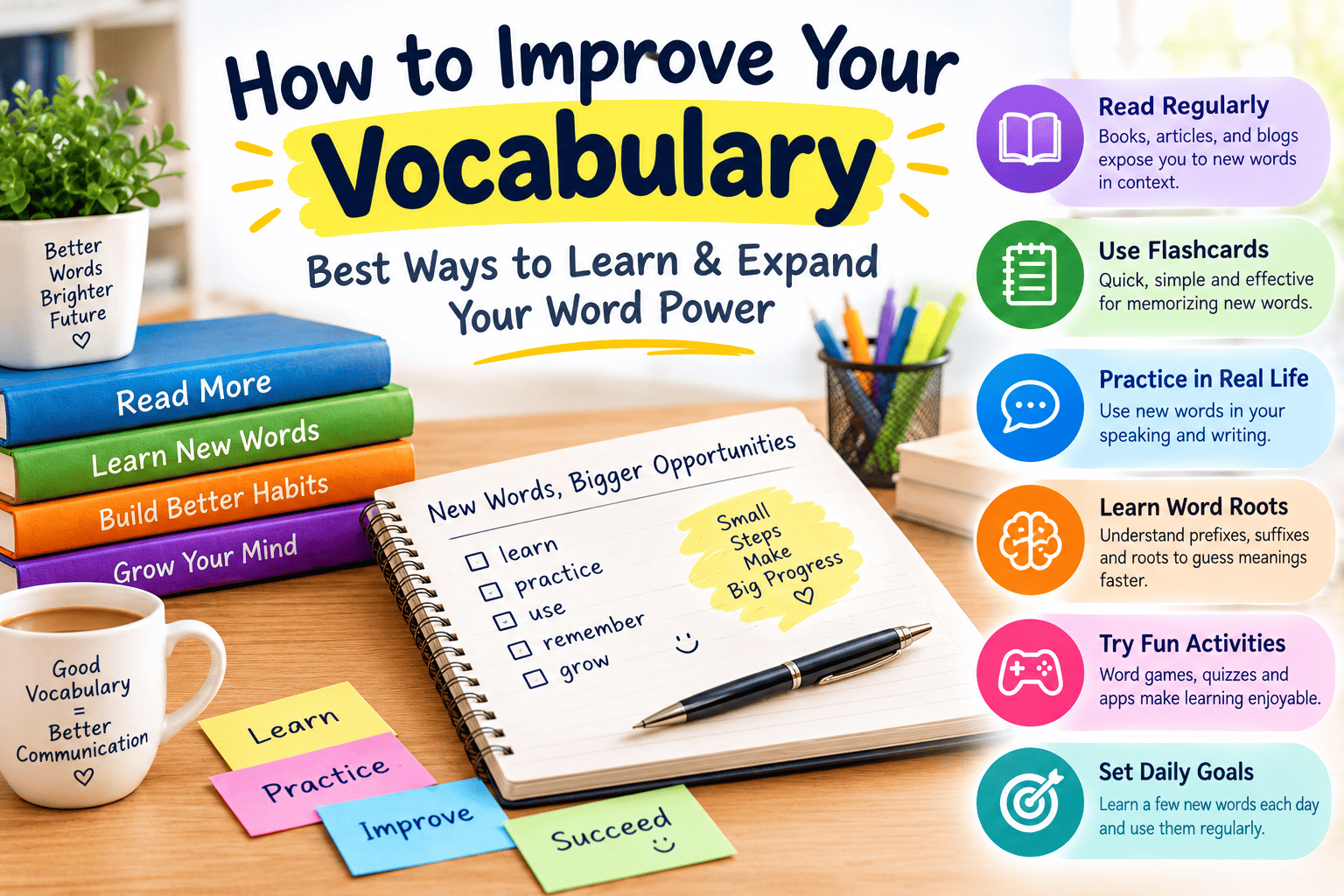
Improving your vocabulary is one of the most effective ways to become a better reader, writer, speaker, and communicator. A strong vocabulary helps you express your thoughts clearly, understand unfamiliar information, and feel more confident when communicating in English. Whether you are a student, a professional, or someone learning English as a second language, developing your vocabulary can make a noticeable difference in your daily life.
The good news is that you do not need to memorize hundreds of words every day to make progress. With consistent practice, regular reading, and the right learning techniques, you can gradually build a vocabulary that is useful in real conversations and writing. In this guide, you will discover the best ways to learn vocabulary, how to expand your English vocabulary, and how to remember new words for longer.
Why Is Vocabulary Important?
Vocabulary is the collection of words you understand and use when reading, writing, speaking, and listening. The more words you know, the easier it becomes to understand other people and communicate your own ideas accurately. Vocabulary also helps you understand books, follow conversations, write professional emails, and perform better in academic settings.
For English learners, vocabulary is especially important because knowing grammar alone is not enough to communicate effectively. You may understand how to form a sentence but still struggle to express yourself if you cannot find the right words. Building your vocabulary gives you more options and allows you to communicate with greater clarity and confidence.
10 Best Ways to Improve Your Vocabulary
There are several practical ways to improve vocabulary without making learning complicated. The most effective approach combines reading, listening, writing, speaking, and regular review.
1. Read Every Day
Reading is one of the best ways to expand your vocabulary naturally. Books, news articles, blogs, short stories, and educational materials introduce you to words in meaningful contexts. When you see a word used in a sentence, you can often understand its meaning from the surrounding information.
Choose reading material that matches your current English level. If every sentence contains unfamiliar words, reading may become frustrating. Start with material you can mostly understand and gradually move toward more challenging content. When you encounter an unfamiliar word, write it down and review its meaning after finishing the paragraph.
2. Learn New Words in Context
Memorizing definitions can be useful, but learning words in context often makes them easier to remember. Instead of studying a word by itself, learn how it works in a complete sentence.
For example, you might learn the word “reluctant,” which means unwilling or hesitant to do something. Rather than memorizing only the definition, remember a sentence such as, “She was reluctant to speak in front of the audience.”
This method helps you understand not only what a word means but also how to use it naturally. It is one of the best ways to learn vocabulary that you can apply in everyday communication.
3. Create a Personal Vocabulary List
A vocabulary list gives you a convenient place to record unfamiliar and useful words. You can keep a notebook, use a spreadsheet, or maintain a digital list on your phone.
For each word, include its definition, pronunciation, an example sentence, and a synonym when appropriate. For instance, the word “essential” means necessary or extremely important. You could remember it through the sentence, “Regular practice is essential for language learning.”
Review your list regularly instead of continually adding new words without revisiting older ones. This simple habit can help you develop a stronger and more organized vocabulary.
4. Use a Word of the Day
Learning a vocabulary word of the day is an easy way to make progress when you have limited time. Choose one useful word, understand its meaning, and write two or three sentences using it.
For example, your word of the day might be “adapt,” meaning to adjust to a new situation or condition. You could write, “Students must adapt to new learning methods.”
One word a day may seem like a small amount, but consistent learning adds up. The important part is to review previous words and practice using them rather than simply collecting definitions.
5. Learn Synonyms and Antonyms
Synonyms are words with similar meanings, while antonyms have opposite meanings. Learning them together helps you understand the relationships between words and choose more precise expressions.
For example, “happy” has synonyms such as “pleased” and “delighted.” An antonym is “unhappy.” Similarly, “difficult” can be replaced by “challenging” in many contexts, although the words are not always interchangeable.
Learning related words helps you avoid repeating the same expressions in every sentence. It also makes your writing more varied and improves your understanding of word meanings.
6. Practice Speaking and Writing
One of the most effective ways to improve your vocabulary is to use new words actively. Reading and listening help you recognize words, but speaking and writing help you become comfortable using them yourself.
Choose five recently learned words and write a short paragraph that includes them. You can also use those words when describing your day, discussing a topic, or practicing English conversation.
Do not worry about making every sentence perfect. Focus on using each word correctly and naturally. With repeated practice, unfamiliar vocabulary can gradually become part of your everyday language.
7. Use Vocabulary Apps and Online Resources
Vocabulary apps can make learning more convenient by providing definitions, example sentences, quizzes, flashcards, and progress tracking. Some tools also use spaced repetition, a technique that schedules reviews at intervals to strengthen memory.
Choose a resource that matches your learning goals. Beginners may benefit from basic English vocabulary exercises, while advanced learners may prefer academic words, synonyms, and more challenging reading activities.
Online dictionaries can also help you check pronunciation, word forms, and examples of correct usage. Use digital tools to support active learning rather than relying on them without practicing the words.
8. Play Vocabulary Games and Take Quizzes
Vocabulary games can make learning more enjoyable and encourage regular practice. Word puzzles, matching exercises, spelling games, and vocabulary quizzes help you test your knowledge in different ways.
Quizzes are particularly useful because they reveal which words you remember and which ones need more attention. If you answer a question incorrectly, review the definition and use the word in a sentence.
Try to make practice a regular habit. Even a short vocabulary quiz each day can help you monitor your progress and identify areas that need improvement.
9. Listen to English Podcasts and Videos
Listening to English podcasts, interviews, audiobooks, and educational videos exposes you to vocabulary used in natural communication. It can also improve your ability to recognize pronunciation, understand common expressions, and follow conversations at different speeds.
Choose content that interests you, such as technology, travel, education, sports, or personal development. When you hear an unfamiliar word repeatedly, look it up and note how the speaker uses it.
If a video includes subtitles, use them to connect spoken words with their written forms. Over time, regular listening can help you recognize more vocabulary without needing to translate every sentence.
10. Review Words Using Spaced Repetition
Forgetting new words is normal, especially when you do not use them regularly. Spaced repetition helps address this problem by reviewing words at increasing intervals rather than studying everything in one session.
For example, review a new word on the day you learn it, then again the next day, several days later, and a week afterward. Adjust the schedule depending on how well you remember it.
Flashcards are a simple way to use this technique. Write the word on one side and its meaning or an example sentence on the other. Testing yourself before looking at the answer can make practice more effective.
How to Expand Your English Vocabulary Faster
If you want to expand your English vocabulary efficiently, focus on useful words that appear frequently in reading, conversation, and writing. Learning rare words can be interesting, but everyday and academic vocabulary often provides more immediate benefits.
Start by identifying the situations in which you need better vocabulary. If you are preparing for exams, focus on academic words and subject-specific terminology. If your goal is better conversation, prioritize common expressions, phrasal verbs, and words used in daily life. If you want to improve professional writing, learn vocabulary related to your industry.
Try combining several methods instead of relying on just one. Read for 15 minutes, record a few unfamiliar words, review older vocabulary, and use the new words in sentences. This balanced approach supports both understanding and practical use.
How Can I Improve My Vocabulary Every Day?
You can improve your vocabulary by following a simple daily routine that fits your schedule. You do not need to spend hours studying; consistency matters more than occasional long sessions.
Here is a practical 20-minute routine:
| Time | Activity | Purpose |
| 5 minutes | Review previously learned words | Strengthen memory |
| 5 minutes | Read a short article or passage | Discover vocabulary in context |
| 5 minutes | Learn three new words | Build your word knowledge |
| 5 minutes | Write sentences using new words | Practice active vocabulary |
Follow this routine regularly and adjust it to your level. If you have more time, add English listening or conversation practice. If you are busy, even a shorter session can be useful when you maintain the habit.
Common Mistakes to Avoid When Building Vocabulary
One common mistake is trying to learn too many words at once. Large lists can feel productive, but words are easily forgotten when there is no time to review or use them. Focus on a manageable number of useful words and learn them properly.
Another mistake is memorizing definitions without understanding context. A word can have different meanings depending on how it is used. Always check example sentences and, when necessary, learn common word combinations.
You should also avoid using complicated vocabulary simply to sound intelligent. Clear communication is more important than choosing the most difficult word. Select vocabulary that accurately expresses your meaning and suits your audience.
Finally, do not become discouraged when you forget a word. Review is a normal part of learning. Repeated exposure and practice will gradually make vocabulary easier to recall.
How to Measure Your Vocabulary Progress
Tracking your progress helps you understand whether your learning methods are working. You can take an online vocabulary test, complete practice quizzes, or maintain a list of words you have learned and used correctly.
However, the number of words you memorize is not the only measure of improvement. Pay attention to whether you understand more of what you read, recognize more words when listening, and express yourself more confidently in writing and conversation.
You can also revisit a reading passage that was difficult a few weeks earlier. If you understand more of its vocabulary now, that is a useful sign of progress.
Frequently Asked Questions
How can I improve my vocabulary quickly?
Read regularly, learn useful words in context, use flashcards, and practice new words in sentences. Reviewing vocabulary consistently is more effective than trying to memorize a large number of words in one sitting.
What are the best ways to learn vocabulary?
The best methods include reading, listening to English, keeping a vocabulary notebook, learning synonyms and antonyms, using flashcards, and practicing speaking and writing.
How can I expand my vocabulary in English?
Choose reading material suited to your level, record unfamiliar words, learn their meanings and examples, and use them in your own sentences. Regular practice helps you recognize and use more English vocabulary.
How many new words should I learn each day?
There is no single number that works for everyone. Starting with three to five useful words per day can be manageable for many learners. Focus on remembering and using words correctly rather than reaching a particular number.
Are vocabulary apps useful?
Yes. Vocabulary apps can provide flashcards, quizzes, pronunciation guides, and review schedules. They work best when combined with reading, writing, listening, and speaking practice.
How long does it take to improve vocabulary?
Progress depends on your current level, learning frequency, and practice methods. You may notice improvements within a few weeks of consistent study, but developing a broad vocabulary is a long-term process.
Final Thoughts
Learning how to improve vocabulary does not have to be difficult. The most effective approach is to make vocabulary practice part of your everyday routine. Read regularly, learn words in context, keep a personal vocabulary list, take quizzes, and use new words in speaking and writing.
Whether your goal is to improve academic performance, communicate confidently in English, or become a better writer, consistent practice will help you move forward. Start with a few useful words today, review them regularly, and gradually expand your vocabulary as your skills develop.