

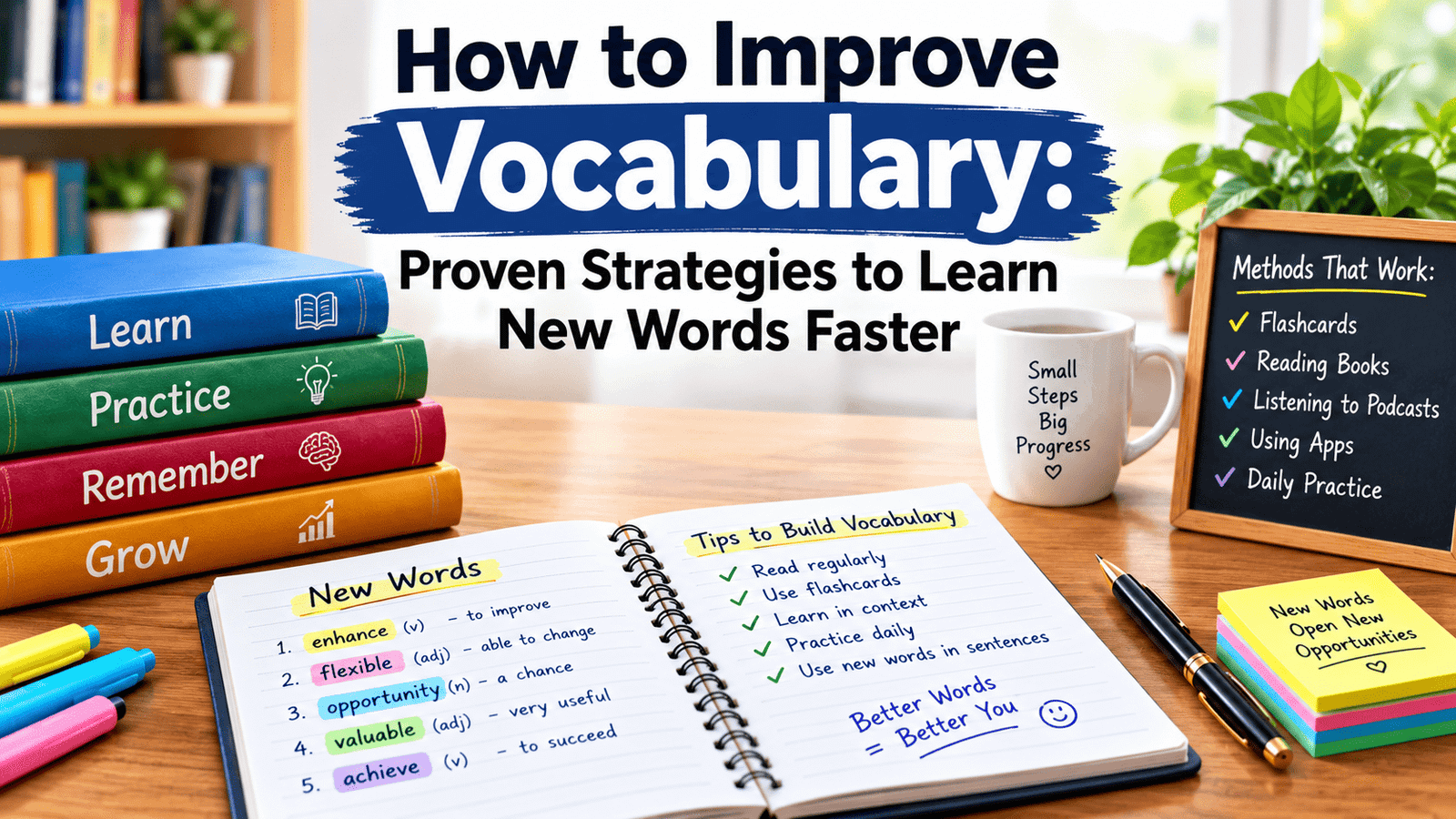
The best way to improve vocabulary is to learn new words in context, read regularly, keep a personal word list, practice using unfamiliar words in sentences, and review them consistently. Instead of memorizing long lists, focus on understanding meaning, pronunciation, synonyms, antonyms, and real-life usage. Daily reading and active practice can gradually make your vocabulary stronger and more natural.
Introduction
A strong vocabulary can make communication clearer, writing more effective, and reading easier. Whether you are a student, professional, language learner, or someone who simply wants to communicate more confidently, learning new words can make a noticeable difference. However, improving vocabulary is not about memorizing hundreds of difficult words overnight. It is about developing a regular habit of discovering, understanding, and using words correctly.
Many people ask how to improve vocabulary because they understand English reasonably well but struggle to find the right words when speaking or writing. The solution is usually consistent exposure and active practice. When you encounter a new word repeatedly in meaningful situations, it becomes easier to remember and eventually use naturally.
Why Is a Good Vocabulary Important?
Vocabulary is one of the foundations of effective language skills. Knowing more words gives you more ways to express ideas, describe experiences, explain opinions, and understand information. A broader vocabulary can also help you recognize differences between words that may have similar meanings but are used in different situations.
For students, vocabulary development can support reading comprehension, writing assignments, presentations, and academic learning. For professionals, a strong word bank can make emails, reports, conversations, and presentations more precise. Even in everyday communication, knowing the right words can make it easier to explain exactly what you mean.
1. Read Every Day
Regular reading is one of the most practical ways to build vocabulary. Books, newspapers, magazines, blogs, essays, and quality online articles expose you to words that may not appear in everyday conversations.
Do not worry about understanding every unfamiliar word immediately. When you come across a new term, first try to understand its meaning from the surrounding sentences. Then check a dictionary if you still need clarification. Seeing the word in context helps you understand not only its definition but also how it is normally used.
Choose reading material that is slightly challenging but still interesting. If every sentence contains several unfamiliar words, reading can become frustrating. A mixture of familiar and new vocabulary creates a better learning experience.
2. Learn Words in Context
Memorizing isolated definitions is often less effective than learning words through sentences. For example, instead of simply remembering that “reluctant” means unwilling or hesitant, notice how the word works in an actual sentence.
Context tells you how a word behaves. It can show whether the word is formal or informal, positive or negative, commonly used in conversation, or more appropriate for academic writing. This makes contextual vocabulary learning especially useful for English learners.
Whenever you discover a new word, try to find or create two or three sentences using it. The goal is to connect the word with an idea rather than memorizing a definition mechanically.
3. Keep a Personal Vocabulary Journal
A vocabulary notebook can turn random new words into an organized learning system. Whenever you find an unfamiliar or useful word, write it down along with its meaning and an example sentence.
You can also include pronunciation, synonyms, antonyms, and related forms of the word. For example, when learning “decide,” you might also explore “decision,” “decisive,” and “indecisive.”
Your vocabulary journal does not need to contain hundreds of entries immediately. Start with a manageable number of useful words and review them regularly. Over time, the collection can become a valuable personal word bank.
4. Use a Dictionary and Thesaurus
A good dictionary does more than provide a definition. It can help you understand pronunciation, grammatical information, example sentences, word forms, and different meanings.
A thesaurus can also help you discover synonyms, but similar words are not always interchangeable. For example, two words may have nearly the same basic meaning but differ in tone or usage. Always check examples before replacing one word with another.
Using these resources teaches you to become more independent when learning new vocabulary.
5. Practice Using New Words
One of the biggest differences between recognizing a word and actually knowing it is the ability to use it. You may understand a word while reading but struggle to remember it during a conversation.
To solve this problem, actively use new vocabulary. Write a short paragraph, create example sentences, describe something around you, or use the word during a conversation when appropriate.
The more meaningful opportunities you create to use a word, the easier it becomes to retrieve it later.
6. Learn Synonyms and Antonyms
Synonyms and antonyms can expand your vocabulary while helping you understand relationships between words. If you learn “generous,” for example, you can explore words such as “giving,” “charitable,” or “selfless,” depending on the context.
Antonyms can provide another useful connection. Words such as “generous” and “selfish” represent contrasting ideas, making the meanings easier to organize mentally.
However, avoid simply collecting huge lists of synonyms. Focus on understanding how each word is actually used.
7. Improve Vocabulary Through Listening
Vocabulary development is not limited to reading and writing. Listening to English can introduce you to natural expressions, pronunciation, sentence patterns, and everyday vocabulary.
Podcasts, educational videos, interviews, audiobooks, and conversations can all provide useful language exposure. Pay attention to words and phrases that speakers repeat or use in interesting contexts.
If you hear an unfamiliar expression, write it down and investigate its meaning later. This combines listening practice with active vocabulary learning.
8. Use Spaced Review
Forgetting newly learned words is completely normal. Instead of trying to memorize everything in one session, review vocabulary at increasing intervals.
You might review new words after one day, several days later, and again the following week. During each review, try to recall the meaning before looking at the answer.
This approach, commonly known as spaced repetition, gives your brain repeated opportunities to retrieve information and strengthen memory.
9. Learn Word Roots and Prefixes
Understanding common prefixes, suffixes, and word roots can help you recognize unfamiliar vocabulary. Once you understand how certain word parts work, a new word may become easier to interpret.
For example, recognizing common prefixes such as “un-,” “re-,” or “dis-” can sometimes provide clues about meaning. Similarly, learning related word forms can help you expand your vocabulary efficiently.
This does not mean that every unfamiliar word can be decoded perfectly from its parts. Think of word roots as clues rather than guaranteed definitions.
10. Make Vocabulary Practice Part of Your Daily Routine
Consistency is more valuable than occasional intensive study. Spending a short amount of time on vocabulary every day can be more sustainable than trying to learn a large number of words once a week.
A simple daily routine might include reading for 15 minutes, recording a few useful words, reviewing older vocabulary, and writing several sentences using new terms.
The exact routine can vary depending on your goals. What matters most is creating a learning habit that you can maintain.
How to Improve Vocabulary for Speaking
Improving vocabulary for speaking requires active recall. Reading can help you recognize thousands of words, but speaking requires you to retrieve vocabulary quickly.
Practice describing your day, explaining an opinion, summarizing something you watched, or discussing a familiar topic. When you cannot remember a particular word, try describing the idea using simpler language and then look up the word afterward.
Over time, this process can help you become more comfortable finding precise words during conversations.
How to Improve Vocabulary for Writing
Writing gives you an excellent opportunity to experiment with new vocabulary. Start by writing naturally rather than trying to fill your sentences with complicated words.
After completing a paragraph, look for places where a more precise word could improve the meaning. A strong vocabulary is not about using the most difficult words possible. Clear and accurate word choice is generally more valuable than unnecessarily complicated language.
Reading high-quality writing can also show you how vocabulary works within different styles and subjects.
Common Vocabulary Learning Mistakes
Some vocabulary strategies can make learning unnecessarily difficult. Trying to memorize huge word lists without context is one common problem. Another is learning words but never practicing them.
It is also easy to focus too heavily on rare or complicated vocabulary. In most situations, learning common and useful words first provides more practical value. Another mistake is studying new vocabulary without reviewing older words, which makes forgetting more likely.
A balanced approach combines reading, listening, writing, speaking, review, and contextual learning.
A Simple 30-Day Vocabulary Improvement Plan
A structured plan can make vocabulary practice easier to maintain. During the first week, focus on reading and collecting useful words. Try to understand each word from context before checking its definition.
During the second week, begin actively using your selected vocabulary in sentences and short writing exercises. Review the words you collected during the first week instead of continually adding new ones.
During the third week, add listening practice and pay attention to natural expressions. Continue reviewing older words while recording useful new vocabulary.
During the fourth week, concentrate on active use. Write short essays, explain topics aloud, and practice conversations using vocabulary you have learned. At the end of the month, review your vocabulary journal and identify the words you can confidently recognize and use.
How Many Words Should You Learn Each Day?
There is no universal number that everyone needs to learn. Some learners may comfortably study five new words per day, while others may prefer fewer words with deeper practice.
Quality is more important than quantity. If you learn five words and can understand and use them correctly, that may be more valuable than memorizing twenty words and forgetting most of them later.
Choose a daily target that feels manageable and gradually adjust it as your learning habits improve.
Frequently Asked Questions
How can I improve my vocabulary quickly?
Read regularly, learn words in context, review them repeatedly, and use new vocabulary in speaking and writing. Consistent daily practice is more useful than trying to memorize a large list in one sitting.
What is the best way to learn new English words?
Learning words through real sentences and meaningful contexts is a practical approach. Combine reading and listening with dictionary use, personal notes, spaced review, and active practice.
How many new words should I learn every day?
There is no fixed number. A small, manageable set of words that you can remember and use correctly is generally better than a large list that you quickly forget.
Does reading improve vocabulary?
Yes. Regular reading exposes you to new words, expressions, sentence structures, and different styles of language. Reading becomes even more effective when you actively notice and review unfamiliar vocabulary.
How can I remember new vocabulary for longer?
Review new words at spaced intervals and use them in your own sentences. Connecting a word with examples, situations, and related words can also make it easier to remember.
Can watching English videos improve vocabulary?
Yes. Videos can expose you to natural pronunciation, conversational expressions, and vocabulary in context. Subtitles can also help learners connect spoken words with their written forms.
Conclusion
Learning how to improve vocabulary does not require complicated techniques or hours of memorization every day. The most useful approach is to create regular exposure to language and actively work with the words you encounter.
Read consistently, listen to natural English, record useful vocabulary, study words in context, review them over time, and use them in your own communication. With patience and regular practice, your vocabulary can gradually become broader, more precise, and easier to use in everyday English.