

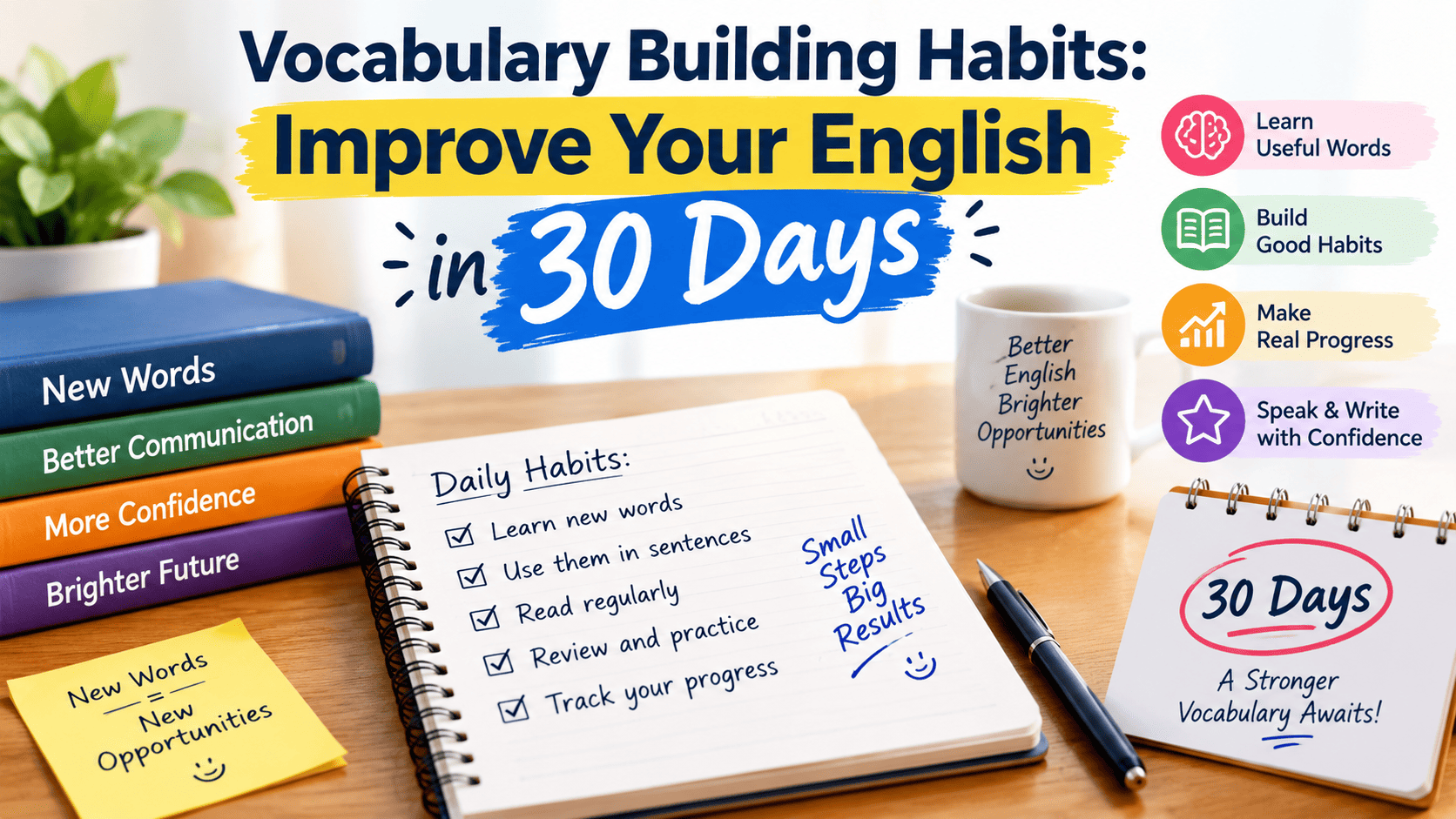
Vocabulary building habits are simple daily practices that help you learn, understand, remember, and use new English words. Reading for 10 minutes, learning five useful words, reviewing previously learned vocabulary, and writing original sentences can make a meaningful difference. A consistent 30-day routine can help you improve word recognition, express ideas more clearly, and develop greater confidence in English speaking and writing. Your progress will depend on your starting level, practice quality, and how regularly you use new words.
Introduction
Learning English becomes easier when you understand the words people use in everyday conversations, books, articles, emails, and educational materials. Grammar helps you arrange words correctly, but vocabulary allows you to communicate your ideas with greater accuracy and confidence. Whether you are a student, a professional, or someone learning English as a second language, expanding your vocabulary can improve several aspects of communication.
However, memorizing long lists of unfamiliar words is not always the most effective approach. You might remember a definition today but struggle to use the same word in a conversation tomorrow. This often happens because recognizing a word and using it naturally are two different skills. To develop lasting vocabulary knowledge, you need repeated exposure, meaningful examples, active practice, and regular review.
The good news is that you do not need to spend hours studying every day. A manageable routine of 15–25 minutes can help you build a stronger learning habit. By choosing useful words, reviewing them at suitable intervals, and applying them in real situations, you can make steady progress over 30 days. The following guide explains which habits work, how to practice them, and how to measure your improvement without overwhelming yourself.
1. Learn a Small Number of Useful Words Every Day
One of the simplest vocabulary-building habits is learning a small, manageable number of words daily. Instead of attempting to memorize 30 or 50 words at once, begin with five words that are relevant to your daily life, studies, or work. This gives you enough time to understand their meanings and practice using them correctly.
For example, you could learn reliable, improve, explain, confident, and essential. These words appear in many common situations and can help you communicate more precisely. Write each word in a notebook, add a simple definition, and create a sentence based on your own experience.
Consider the word reliable. Its meaning is trustworthy or dependable. You could write, “My friend is reliable because she always keeps her promises.” This sentence connects the word with a familiar situation, making it easier to understand and remember.
The goal is not to collect the largest possible number of words. It is to develop a vocabulary you can actually use. Five words learned and practiced properly may be more valuable than 20 words whose meanings you quickly forget. Adjust the number according to your schedule and current English level.
2. Read English Every Day
Reading exposes you to vocabulary in context, helping you understand not only what a word means but also how writers use it. Books, short stories, educational articles, newspapers, and well-written blog posts can introduce you to different expressions and sentence structures.
Choose material that is interesting and reasonably easy to understand. If every sentence contains several unfamiliar words, the reading experience may become frustrating. Beginners can start with graded readers or short articles, while intermediate learners may prefer longer stories and informative content.
When you encounter an unfamiliar word, first examine the surrounding sentence. Look at the topic and the words near it to make an educated guess about its meaning. Then check a reliable dictionary to confirm your understanding. Record only the words that are useful enough to learn.
For example, consider this sentence: “The team made a significant improvement in its performance.” Even if you do not know significant, the sentence suggests that the improvement was important or noticeable.
Spend around 10 minutes reading each day. You can gradually increase this time when it fits your routine. Regular reading helps you meet familiar words repeatedly and introduces new vocabulary without turning every learning session into a memorization exercise.
3. Use a Vocabulary Notebook
A vocabulary notebook gives you one organized place to record and review new words. You can use a traditional notebook, a digital document, or a notes application. The format matters less than how consistently you use it.
For each word, record its meaning, pronunciation if needed, part of speech, an example sentence, and one related word or phrase. You can also write down common word combinations because English words often appear together in predictable patterns.
For instance, the word decision is commonly used in expressions such as “make a decision,” “reach a decision,” and “a difficult decision.” Learning these combinations is more practical than memorizing the word alone.
Keep your notes simple and easy to review. A useful entry might look like this:
| Word | Meaning | Example |
| Accurate | Correct and free from errors | Please provide accurate information. |
| Curious | Eager to learn or know something | She is curious about science. |
| Improve | To make something better | I want to improve my writing. |
| Opportunity | A suitable chance to do something | The course offers an opportunity to learn. |
| Efficient | Working well without wasting time | This method is efficient and simple. |
Review your notebook regularly rather than allowing hundreds of entries to accumulate without practice. You can cover the definitions and test yourself, or read the meanings and try to recall the words. This turns your notebook into an active learning tool.
4. Review Words Using Spaced Repetition
Repeated review helps strengthen your memory, particularly when you revisit words after gradually increasing intervals. This approach is known as spaced repetition. Rather than studying the same list repeatedly in one sitting, return to the words over several days.
For example, after learning a new word, review it later that day, the following day, a few days later, and again the next week. The exact schedule can vary. If a word is easy to remember, you may need fewer reviews. If you repeatedly forget it, practice it more often.
Flashcards are useful for this habit. Write the word on one side and its meaning or an example sentence on the other. Before checking the answer, try to recall it yourself. You can make physical cards or use a digital flashcard application.
Do not treat every forgotten word as a failure. Forgetting is a normal part of learning, and attempting to recall information helps reveal what needs more practice. When you miss a word, review its meaning, read it in context, and use it in a new sentence.
A short review session of five minutes can be more useful than spending a long time rereading definitions without testing yourself. The important point is to revisit vocabulary over time and actively retrieve what you have learned.
5. Learn Words in Context Instead of Memorizing Definitions Alone
A dictionary definition provides useful information, but context shows how a word works in real communication. Some English words have multiple meanings, and their intended meaning depends on the sentence in which they appear.
Take the word bright. It can describe strong light, a vivid color, or someone who learns quickly. Compare these examples: “The room is bright,” “She wore a bright yellow jacket,” and “He is a bright student.” The word remains the same, but its meaning changes according to the context.
When learning vocabulary, collect complete sentences from reliable reading material. Notice the situation, the surrounding words, and the grammatical structure. Then create your own example that uses the word in a similar way.
You should also pay attention to register. Some expressions are appropriate for formal writing, while others are more natural in casual conversations. For example, purchase is often more formal than buy. Both can be correct, but the best choice depends on the situation.
This method helps you move beyond knowing a rough definition. You begin to understand how a word behaves, what other words commonly accompany it, and when it sounds natural to use it.
6. Practice Speaking With Your New Vocabulary
Speaking is an important way to turn passive vocabulary into active vocabulary. Passive vocabulary includes words you can recognize when reading or listening. Active vocabulary includes words you can recall and use when expressing your own ideas.
You do not need a conversation partner every time you practice. Start by describing your day aloud, explaining a simple topic, or summarizing something you recently read. Try to include two or three words from your notebook.
Suppose you are learning convenient, affordable, and recommend. You might say, “I recommend this affordable restaurant because its location is convenient.” One sentence allows you to practice three words in a meaningful situation.
You can also record a short voice note and listen to it afterward. Notice whether you used the words correctly and whether your sentences communicated your ideas clearly. If you are unsure about a word’s pronunciation or usage, check a trusted dictionary or a reliable learning resource.
Avoid forcing every new word into every conversation. Natural communication matters more than displaying complicated vocabulary. If a simpler word expresses your meaning accurately, it may be the better choice. Over time, repeated speaking practice can help useful words become easier to recall.
7. Write a Few Sentences Every Day
Daily writing provides a practical way to test your vocabulary knowledge. You can write a short diary entry, describe a recent experience, summarize an article, or explain your opinion about a familiar topic.
Choose three new words and write one or two sentences using them. For example, if you are learning challenge, progress, and determined, you might write: “Learning English can be a challenge, but I am determined to make progress every week.”
After writing, check whether the words fit their sentences. Confirm their meanings, spelling, and grammatical forms. A dictionary can help you identify whether a noun, verb, adjective, or adverb is required.
You can make the exercise more useful by revisiting previous entries. Try rewriting an older paragraph with more precise vocabulary, but do not replace simple words merely to make the writing sound complicated. The purpose is to express ideas clearly.
A five-minute writing exercise is enough to get started. As your confidence improves, write longer paragraphs or short summaries. This habit develops vocabulary alongside sentence construction, spelling, and written communication.
8. Learn Synonyms, Antonyms, and Word Families
Related words help you expand your vocabulary more efficiently. Synonyms have similar meanings, antonyms express contrasting meanings, and word families include related forms created from the same base or root.
For example, happy has related words such as cheerful, pleased, and delighted. However, these words are not always interchangeable. “Delighted” often communicates stronger pleasure than “pleased,” while “cheerful” can describe someone’s general mood.
Antonyms can clarify meaning by showing contrast. Examples include increase and decrease, generous and selfish, or temporary and permanent. Learning both sides of a contrast can make unfamiliar vocabulary easier to understand.
Word families are also valuable. Consider success (noun), successful (adjective), and successfully (adverb). Understanding these forms helps you choose the correct word in a sentence.
Practice by selecting one word each day and finding two or three useful related forms. Check example sentences before assuming that similar words have identical meanings. This approach increases your vocabulary while helping you use words more accurately in speaking and writing.
9. Listen to English and Notice New Expressions
Listening helps you understand how vocabulary is used in natural speech. Conversations, educational podcasts, interviews, audiobooks, and English-learning videos can expose you to common expressions, pronunciation patterns, and everyday phrases.
Choose content that matches your level and interests. If you enjoy technology, listen to a short technology discussion. If you prefer stories, choose an audiobook or a narrated short story. Interest makes it easier to maintain the habit.
During a listening session, identify one or two useful expressions. Listen to the relevant sentence again if necessary, then write down the expression and its meaning. Try to use it in a new sentence of your own.
For example, you might hear “figure out” in the sentence, “I need to figure out how this application works.” The expression means to understand or solve something. Learning the complete phrase is more helpful than treating each word separately.
You can use subtitles when they improve understanding, but occasionally listen without reading them to test your comprehension. Repeat short phrases aloud if you want pronunciation practice. A brief daily listening routine can reinforce vocabulary that you encounter through reading and writing.
10. Use a Dictionary to Check Meaning and Usage
A reliable dictionary helps you avoid learning incorrect meanings or using words in unnatural ways. When you discover a new word, check its definition, pronunciation, part of speech, and example sentences. If the word has several meanings, identify the one that fits your situation.
Learners can use established resources such as Cambridge Dictionary, Oxford Learner’s Dictionaries, or Merriam-Webster. Different dictionaries may provide slightly different explanations, so focus on the examples and usage information most relevant to your needs.
Pay attention to grammar patterns. For example, some verbs are commonly followed by a particular preposition or grammatical structure. Learning these patterns can prevent mistakes that a simple translation might not reveal.
Avoid selecting complicated synonyms without checking their tone and meaning. A word may look similar to another word but carry a different implication. Likewise, a translation that works in one sentence may not be suitable in another.
A dictionary should support your learning rather than interrupt every sentence. When reading, try to infer a meaning first, then check important or repeated unfamiliar words. This balances independent comprehension with accuracy.
11. Change Your Daily Activities Into Vocabulary Practice
You can build vocabulary through ordinary activities instead of relying exclusively on textbooks. Describe objects in your room, write a shopping list in English, read product instructions, or explain how you completed a task.
For example, while preparing a meal, you might practice words such as ingredient, measure, combine, and prepare. When organizing your schedule, you could use priority, deadline, arrange, and complete. Vocabulary connected to real activities is often easier to remember because it has a clear purpose.
You can also change your device language to English if you are comfortable doing so. Read short notices, application instructions, and everyday messages carefully. Keep a list of expressions you repeatedly encounter and want to understand better.
Another useful activity is describing a picture in five sentences. Mention what you see, where objects are located, what people are doing, and what might happen next. This exercise encourages you to recall descriptive words and action verbs.
The main advantage of everyday practice is that it connects English with situations you already understand. Instead of learning every word in isolation, you gradually develop vocabulary that helps you complete tasks and communicate more naturally.
12. Avoid Common Vocabulary Learning Mistakes
Several habits can slow vocabulary development. One common mistake is memorizing long word lists without using the words. Recognition may improve, but you can still struggle to recall vocabulary during a conversation. Add example sentences, short writing tasks, and speaking practice to make learning more active.
Another mistake is learning rare or complicated words before mastering common vocabulary. Advanced terms can be useful, but everyday words and expressions usually have greater immediate value for beginners and intermediate learners. Choose words based on your goals, reading material, and daily communication needs.
Ignoring review is another problem. If you never revisit previously learned words, you may gradually forget them. A few minutes of spaced review can help you identify which words need more attention.
Avoid translating every word directly from your first language. Translation can be helpful, but English expressions do not always follow the same patterns as expressions in other languages. Read examples and learn common phrases as complete units.
Finally, do not judge your progress only by the number of words in your notebook. Measure whether you can recognize words, explain their meanings, understand them in context, and use them correctly. Practical knowledge is a better indicator of progress than a long list of definitions.
13. Your 30-Day Vocabulary Building Plan
A clear schedule makes vocabulary practice easier to maintain. The following plan gradually introduces new habits while leaving time for review. Adjust the activities to match your English level and available time.
Days 1–7: Build Your Foundation
During the first week, focus on establishing a realistic daily routine. Choose five useful words each day, read a short English passage, and record example sentences in your vocabulary notebook.
On Day 1, assess your current habits and choose a reading source. On Days 2 and 3, practice identifying unfamiliar words from context. On Days 4 and 5, review earlier words and write original sentences. On Day 6, speak for two minutes about a familiar topic using some of your new vocabulary. On Day 7, test yourself without looking at your notes.
Do not worry if you cannot remember every word. Use the first week to discover which learning methods help you most. By the end of this stage, you should have an organized notebook and a daily routine you can continue.
Days 8–14: Improve Understanding and Recall
In the second week, continue learning new words while reviewing those from the previous seven days. Add spaced repetition to your routine and pay closer attention to example sentences.
Read slightly longer passages if your current material feels comfortable. Practice learning phrases and word combinations rather than collecting isolated vocabulary. For instance, record “pay attention,” “make progress,” and “solve a problem” as complete expressions.
Write a short paragraph on three or four days of the week and speak aloud on the other days. Include vocabulary from earlier sessions instead of using only the newest words.
On Day 14, complete a review test. Select 20 words from your notebook, explain their meanings, and write sentences with as many as you can. Record which words remain difficult so you can revisit them during the next stage.
Days 15–21: Use Vocabulary More Actively
The third week focuses on applying words in real communication. Continue reading and reviewing, but spend more time writing, speaking, and summarizing information.
Choose a familiar topic such as education, hobbies, technology, travel, or daily routines. Learn relevant vocabulary and use it to describe your opinions or experiences. For example, if your topic is education, you might practice assignment, concentrate, explain, effective, and achievement.
Try summarizing a short article in five sentences. Then explain the same topic aloud without reading your summary. This exercise helps you practice retrieving vocabulary from memory rather than simply recognizing it on a page.
At the end of the week, identify words you can use comfortably and those you still understand only when reading. Review the second group with fresh examples and additional speaking or writing practice.
Days 22–30: Consolidate and Measure Progress
During the final stage, focus on strengthening the vocabulary you have already learned. Continue adding useful words, but give additional attention to review and accurate usage.
Read a short article daily and write a brief summary on several days. Use flashcards to test older vocabulary, and record a short spoken explanation of a familiar topic. Try to include words from the beginning of the month rather than relying exclusively on recently learned expressions.
On Day 28, review your notebook and identify common patterns in your mistakes. You may discover that you remember definitions but struggle with spelling, pronunciation, or word combinations. Use the remaining days to practice those areas.
On Day 30, repeat the type of assessment you completed at the beginning of the plan. Compare your ability to understand, recall, and use vocabulary. Your results will show which habits deserve a permanent place in your routine. Remember that 30 days is a starting point for progress, not a guarantee of fluency.
14. A Simple Daily Routine for Busy Learners
You do not need to follow a complicated schedule to build vocabulary consistently. A short routine can work well when each activity has a clear purpose.
| Time | Activity | Purpose |
| 5 minutes | Review old words | Strengthen recall |
| 5 minutes | Learn up to five new words | Expand vocabulary |
| 10 minutes | Read or listen to English | Meet words in context |
| 5 minutes | Write or speak using new words | Practice active use |
This routine takes approximately 25 minutes. If you have less time, shorten the reading or practice session instead of abandoning the habit completely. On busy days, reviewing a few words and writing one sentence is still useful.
Try to practice at a time that fits naturally into your schedule. Some learners prefer the morning, while others find evening review more convenient. Consistency matters more than choosing a supposedly perfect time.
Keep the routine flexible enough to maintain over several weeks. If you miss a day, continue with your next session rather than attempting to complete every missed activity at once. A sustainable learning system is more valuable than a demanding schedule that becomes difficult to follow.
15. How to Measure Your Vocabulary Progress
Tracking your progress helps you understand whether your learning methods are working. However, counting newly recorded words is only one measure. You should also evaluate how well you recognize vocabulary in reading, understand it in listening, and use it in your own sentences.
At the beginning of your 30-day plan, choose 20 familiar or recently learned words and test your knowledge. Write their meanings, create sentences, or explain them aloud. Save your answers so you can compare them with a later assessment.
Repeat a similar exercise after two weeks and again on Day 30. Use a consistent method each time. You might measure the number of definitions you remember, the number of words used correctly in sentences, and the number of unfamiliar words you can infer from context.
Keep track of recurring errors. If you frequently confuse two similar words, create examples that highlight the difference. If you understand words when reading but cannot recall them while speaking, practice short oral summaries.
Progress will not always be linear. Some words will become familiar quickly, while others require more exposure. The aim is to build a vocabulary you can understand and use effectively, not to reach an arbitrary number by a particular date.
Conclusion
Developing a stronger English vocabulary begins with small habits repeated consistently. Reading, keeping a vocabulary notebook, reviewing words at suitable intervals, listening to natural English, and practicing speaking and writing all contribute to better word knowledge.
A 30-day plan gives you a practical way to organize these activities without making learning overwhelming. Start with useful words, study them in context, and return to them regularly. Apply new vocabulary to conversations, personal writing, and everyday situations so that it becomes easier to recall when you need it.
Most importantly, focus on meaningful progress instead of memorizing as many words as possible. If you can understand new expressions, choose appropriate words, and communicate your ideas more clearly, your practice is serving its purpose. Continue using these habits beyond the first month, and vocabulary development can become a lasting part of your English learning journey.
Frequently Asked Questions
1. How can I improve my English vocabulary in 30 days?
Create a daily routine that includes reading, learning a few useful words, reviewing previous vocabulary, and using new words in sentences. Practice speaking and writing regularly, and check unfamiliar words in a reliable dictionary. Thirty days can help you establish stronger habits and make progress, although results vary by learner.
2. How many English words should I learn every day?
Start with three to five useful words daily if you are a beginner or have limited study time. Increase the number only when you can review and use them comfortably. Learning fewer words thoroughly is often more practical than memorizing a long list without understanding how to use it.
3. What is the best way to remember new vocabulary?
Combine spaced repetition with active recall and contextual learning. Review words after increasing intervals, test yourself before checking the answers, and use each word in a meaningful sentence. Reading and listening provide additional exposure that can strengthen your understanding.
4. Does reading improve English vocabulary?
Yes. Reading introduces words in context and shows how they are used in sentences. It also exposes you to grammar patterns, common expressions, and different writing styles. Choose material that matches your level and look up unfamiliar words that are useful or appear repeatedly.
5. Should I use a dictionary or a translation app?
Both can help. A dictionary is particularly useful for definitions, pronunciation, grammatical information, and example sentences. Translation tools can clarify unfamiliar expressions, especially for beginners. For lasting learning, confirm important meanings and practice using words in original English sentences.
6. How can I use new vocabulary in everyday conversation?
Choose a few words related to familiar topics and use them when describing your day, discussing a hobby, or explaining an opinion. You can practice alone by speaking aloud or recording a short voice note. Focus on natural, accurate communication rather than forcing difficult words into every sentence.
7. Can I become fluent in English in 30 days?
Fluency usually requires more than 30 days, particularly for learners starting at a beginner level. A month of consistent vocabulary practice can improve your learning routine, word recognition, and confidence. Long-term progress also depends on grammar, listening, pronunciation, speaking practice, and regular exposure to English.