

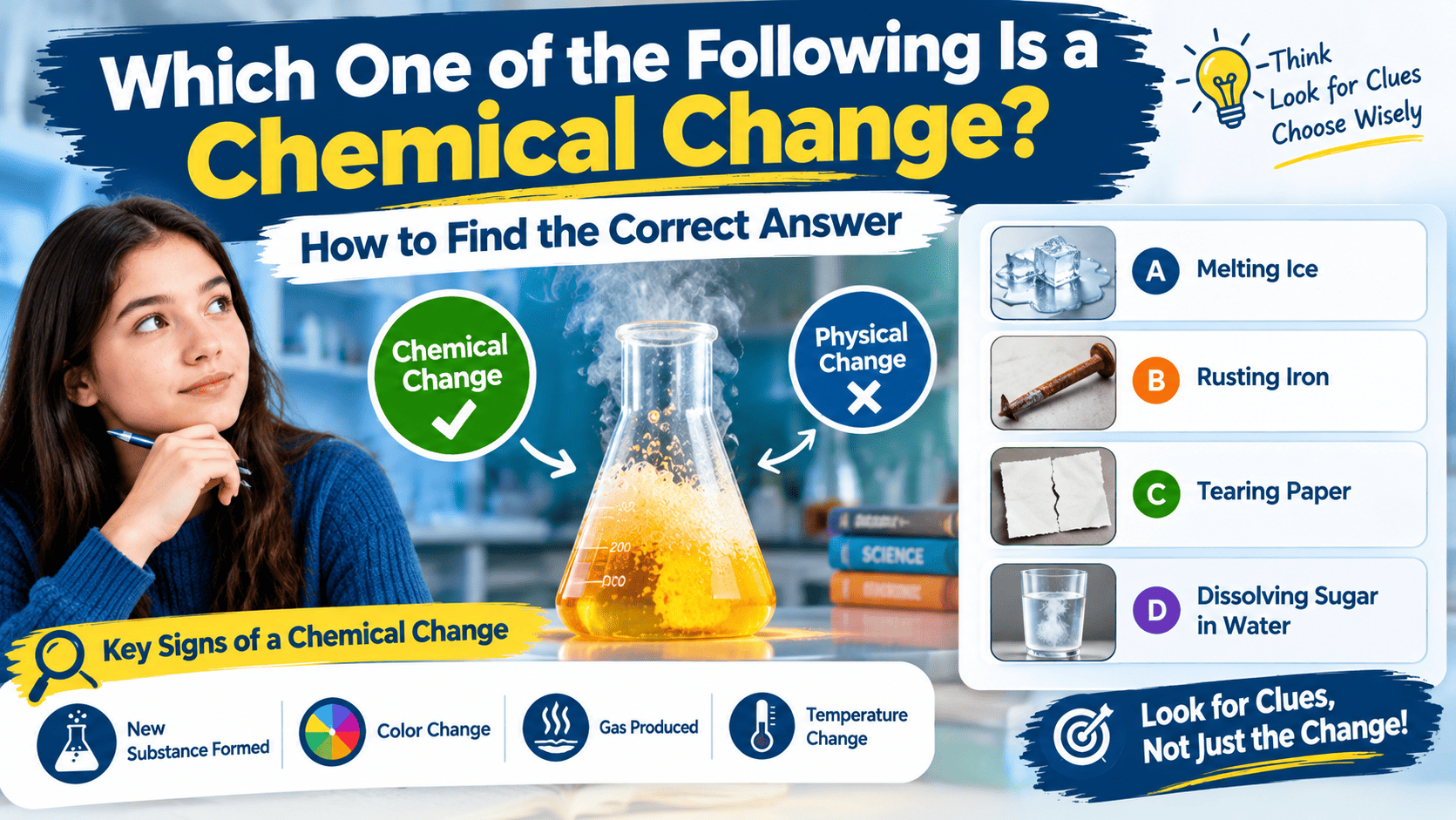
The correct answer depends on the options given in the question. In a typical chemistry multiple-choice question, rusting of iron, burning of wood, or cooking an egg may be the correct answer because these processes involve chemical reactions that produce new substances or chemically transform existing substances. Melting ice, breaking glass, and cutting paper are generally physical changes because they do not change the material’s chemical identity.
Understanding the Question and Its Scientific Meaning
The question “which one of the following is a chemical change” tests whether a student can distinguish a chemical reaction from a physical change. It is common in introductory chemistry because it evaluates a fundamental concept: what happens to matter when it changes?
To answer correctly, students need to look beyond the visible appearance of an object. A material may change color, become smaller, release heat, or change its physical state without necessarily undergoing a chemical reaction. The most reliable approach is to determine whether the process produces substances with a different chemical composition.
For example, when ice melts, solid water becomes liquid water, but the molecules remain H₂O. When iron rusts, however, iron reacts with oxygen and moisture to form iron-containing compounds with properties different from those of the original metal. This distinction is the foundation of identifying chemical changes in science examinations.
What Is a Chemical Change?
A chemical change occurs when a chemical reaction transforms one or more starting substances into products with different chemical compositions. During the reaction, atoms are rearranged as chemical bonds break and form. The atoms themselves are conserved in ordinary chemical reactions, although their arrangement and bonding change.
Chemistry textbooks describe the starting substances as reactants and the resulting substances as products. Consider the reaction between hydrogen and oxygen that produces water. Hydrogen and oxygen are the reactants, while water is the product. The resulting substance has properties different from those of either starting element.
Chemical changes occur in laboratories, industrial processes, living organisms, and everyday activities. Combustion, food digestion, corrosion, and many cooking processes involve chemical reactions. Understanding this concept helps students move beyond memorizing examples and develop a clearer understanding of how matter behaves.
Which Option Is Correct in a Chemical Change MCQ?
Consider this representative multiple-choice question:
Which one of the following is a chemical change?
A. Melting an ice cube
B. Breaking a glass bottle
C. Rusting an iron nail
D. Cutting a piece of paper
Correct answer: C. Rusting an iron nail.
Rusting occurs when iron reacts with oxygen in the presence of moisture, producing rust, which consists mainly of hydrated iron oxides. The newly formed compounds have different chemical properties from the original iron, so rusting is classified as a chemical change.
The other options describe physical changes under ordinary conditions. Melting ice changes the state of water, breaking glass changes its shape and size, and cutting paper changes its dimensions. None of these processes, by itself, changes the chemical identity of the material.
The answer may differ if your actual question contains different options. Therefore, students should evaluate every option rather than automatically selecting rusting or burning whenever they see this keyword.
Chemical Change vs. Physical Change: The Key Difference
A physical change affects a substance’s form, size, shape, or state without changing its chemical identity. A chemical change involves a reaction that produces new substances or changes the chemical composition of the material.
Melting, freezing, boiling, and condensation are common physical changes. In each case, water remains H₂O even though its physical state changes. Breaking a glass bottle is also physical because the fragments remain glass.
Burning wood, rusting iron, and the chemical reactions involved in cooking are different. They transform the starting materials through chemical processes. A useful examination strategy is to ask whether the material merely looks different or whether its chemical composition has changed.
It is also important to understand that reversibility is not a perfect test. Some physical changes are difficult to reverse, and some chemical reactions are reversible. The formation of new substances is a more reliable scientific criterion than whether a process can easily be undone.
Five Examples That Help Explain Chemical Changes
1. Rusting of Iron
Rusting is a classic example of a chemical change. Iron reacts with oxygen and moisture over time, forming corrosion products that include hydrated iron oxides. The reddish-brown layer has different chemical properties from metallic iron. Rusting is therefore more than a change in the metal’s appearance; it is the result of chemical reactions.
2. Burning Wood
When wood burns, its components react with oxygen and produce various substances, including carbon dioxide, water vapor, and ash. The reaction releases energy as heat and light. Because the original wood is chemically transformed, combustion is classified as a chemical change. This example is particularly useful in examinations because the formation of multiple products makes the transformation clear.
3. Cooking an Egg
Cooking an egg causes proteins to unfold and interact in new ways, changing the egg’s texture and structure. Heat also causes other chemical changes in its components. The result differs significantly from the raw egg, and the original structure cannot simply be restored by cooling. Cooking an egg is therefore a useful everyday example of a process involving chemical changes.
4. Baking a Cake
Baking involves several processes, including physical changes and chemical reactions. Leavening agents can release carbon dioxide, proteins change structure, and browning reactions produce new compounds that contribute to the cake’s color and flavor. The overall process cannot be explained by a temperature or shape change alone, making baking a useful example of chemical transformations in everyday life.
5. Mixing Baking Soda and Vinegar
When baking soda reacts with the acetic acid in vinegar, the reaction produces carbon dioxide gas, water, and sodium acetate. The carbon dioxide creates visible bubbles. This is a helpful demonstration of a chemical reaction because the starting substances form products with different chemical compositions.
Signs That a Chemical Reaction May Have Occurred
Chemists look for evidence when determining whether a chemical reaction has taken place. Common indicators include gas production, the formation of a solid from solutions, a persistent color change, and an unexpected temperature change. Light or a new odor may also provide clues in appropriate circumstances.
However, these observations should not be treated as absolute proof on their own. Bubbles can appear when water boils, but boiling is a physical change. A substance may change color because it has been mixed with another material without necessarily undergoing a chemical reaction. The correct conclusion depends on the underlying process and whether new substances form.
For examination purposes, students should use visible signs to guide their reasoning, then connect those signs to the chemical behavior of the substances involved. This is more accurate than assuming that every color change, temperature change, or bubble indicates a chemical reaction.
Common Mistakes Students Make
One common mistake is assuming that every permanent change must be chemical. Breaking glass is difficult to reverse, but it remains a physical change because the glass’s chemical composition has not changed simply because it broke.
Another mistake is classifying every change involving heat as chemical. Melting ice requires energy, but it does not produce a new substance. In contrast, burning wood involves chemical reactions that release energy and generate new products.
Students may also assume that all changes in appearance indicate a chemical reaction. A change in size, shape, or physical state can occur without a change in chemical identity. Understanding the reason behind the change is more useful than memorizing isolated examples.
How to Solve Chemical Change Questions Faster
Start by reading all the options carefully. Identify the process described in each choice, then ask whether it changes only the physical form of the substance or produces new substances through a chemical reaction.
Next, eliminate straightforward physical changes such as melting ice, breaking glass, or cutting paper. Examine the remaining choices for processes such as combustion, corrosion, or chemical reactions involved in cooking. If two choices appear to involve chemical reactions, consider the precise wording of the question rather than assuming only one familiar example can be correct.
Finally, remember the central principle: a chemical change involves a change in chemical composition, whereas a physical change generally preserves the substance’s chemical identity. This approach helps students answer unfamiliar questions instead of relying only on memorized examples.
Frequently Asked Questions
1. Which one of the following is a chemical change?
The answer depends on the options provided. Rusting iron, burning wood, and cooking an egg are common examples of processes involving chemical changes because chemical reactions transform the starting materials.
2. Is melting ice a chemical change?
No. Melting ice is a physical change because solid water becomes liquid water while retaining its chemical identity as H₂O.
3. Why is rusting iron a chemical change?
Iron reacts with oxygen and moisture to form rust, consisting mainly of hydrated iron oxides. These products differ chemically from metallic iron.
4. Is burning paper a chemical or physical change?
Burning paper is a chemical change because combustion produces new substances, including gases and ash. Cutting or tearing paper is a physical change.
5. Can a chemical change be reversed?
Yes. Some chemical reactions are reversible under suitable conditions. Reversibility alone does not determine whether a change is chemical; the formation of new substances is the more useful criterion.
Conclusion
Identifying a chemical change requires understanding what happens to matter during a process. Rusting iron, burning wood, and chemical reactions during cooking are common examples because they involve changes in chemical composition. Melting ice, cutting paper, and breaking glass are physical changes because the material’s chemical identity remains essentially the same.
When answering “which one of the following is a chemical change,” examine the options carefully and focus on the formation of new substances. This scientific approach helps students understand the concept, avoid common mistakes, and answer chemistry multiple-choice questions with greater confidence.