

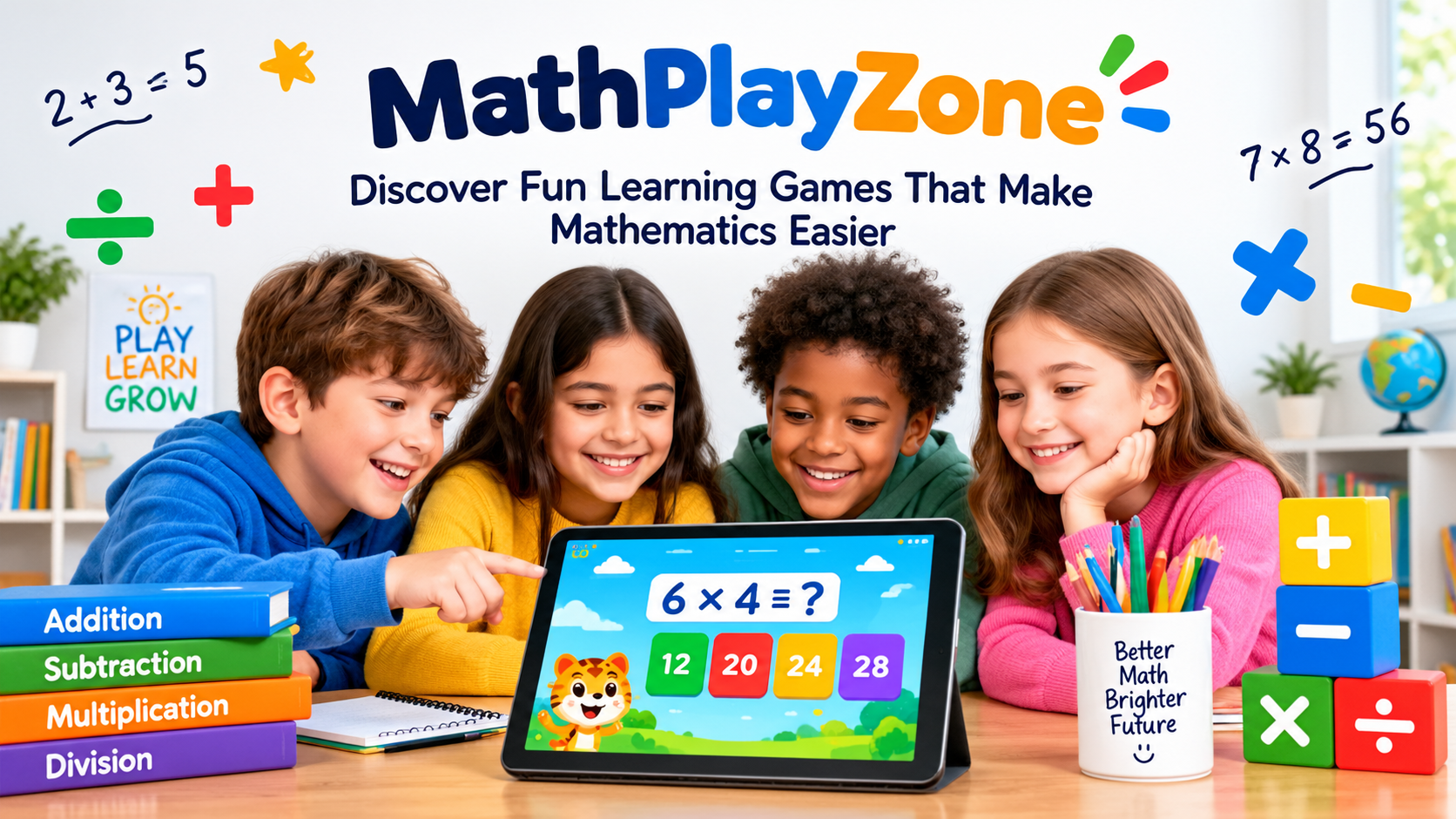
MathPlayZone is an online educational gaming website that combines learning with interactive activities. It features arithmetic challenges, number puzzles, and games covering subjects such as science, history, and geography. Children can practice mathematical skills while enjoying game-based challenges, making it a useful supplementary resource for families and educators who want to make learning more engaging.
Understanding the Platform and Its Purpose
MathPlayZone is designed around a simple educational idea: children can practice academic skills through activities that feel more engaging than traditional worksheets. Instead of only reading explanations or answering questions on paper, learners interact with games, make decisions, and work toward specific objectives. This approach can make practice more enjoyable, especially for children who lose interest when lessons become repetitive.
The official website presents several categories of educational games rather than focusing exclusively on mathematics. Its collection includes arithmetic activities, science quizzes, history and geography games, and other challenges. This broader selection gives families an opportunity to explore different subjects in one place. However, the activities available on the website should be checked directly because game collections and individual features can change over time.
How Online Math Games Support Learning
Interactive mathematics games encourage learners to participate actively. A child might need to calculate a sum, identify the correct answer, arrange numbered blocks, or solve a problem before progressing. Each action provides an opportunity to apply mathematical knowledge instead of simply memorizing information. When activities are matched to a learner’s current ability, repeated practice can help strengthen understanding and improve familiarity with numbers.
Game-based practice is most useful when entertainment supports a clear learning objective. A student who repeatedly solves addition problems, for example, gets more opportunities to recognize number combinations and improve calculation fluency. Nevertheless, enjoying a game does not automatically mean a child has mastered the underlying concept. Adults should occasionally ask learners to explain their answers or solve similar problems without the game.
Addition and Subtraction Practice
Addition and subtraction are foundational skills that support more advanced mathematics. Games built around these operations can help children recognize number relationships, calculate totals, find differences, and respond more confidently to familiar problems. Short rounds are particularly useful for beginners because they allow learners to concentrate on a limited set of skills without feeling overwhelmed by a lengthy assignment.
The official collection includes separate addition and subtraction activities, along with challenges such as Let’s Reach 1000 and Let’s Reach Zero. These games introduce goals that involve adding to or subtracting from a running total. Parents can make practice more meaningful by asking children to explain the calculation behind each move. That small habit helps connect fast-paced gameplay with mathematical reasoning.
Multiplication and Division Challenges
Multiplication and division become easier to understand when children connect equations with patterns and repeated operations. Multiplication games can reinforce times tables, while division activities give learners repeated opportunities to calculate quotients and recognize relationships between numbers. These exercises may be especially helpful for students who understand a concept during a lesson but struggle to recall the correct answer independently.
The website lists dedicated multiplication and division games that use timed questions and selectable answers. Such formats can encourage quick recall, but speed should not become the only measure of success. A learner who answers slowly but accurately may be developing a stronger foundation than someone who guesses rapidly. For best results, combine timed activities with untimed exercises that emphasize calculation methods and explanations.
Logic Puzzles and Strategic Thinking
Mathematics involves more than arithmetic. Students also need to recognize patterns, compare possibilities, plan sequences, and work through unfamiliar problems. Logic-based games provide opportunities to practice these abilities in a setting where each decision affects the outcome. Rather than immediately revealing a solution, a well-designed puzzle encourages children to test an idea, notice mistakes, and adjust their approach.
One example on the official website is Math Push, a puzzle in which players move numbered blocks to create mathematical expressions that match target values. This type of activity combines arithmetic with planning and spatial reasoning. It can be useful for children who enjoy puzzles and need a different way to engage with numbers. Adults can extend the learning experience by asking why a particular arrangement works.
Science, History, and Geography Activities
A broader educational game collection can make online practice more varied. The website also lists activities such as The Brain Lab, Smarty Pants: Science Quiz, The Magic of Science, Smarty Pants: History Quiz, Smarty Pants: Geography Quiz, and Flags Maniac. These games cover topics beyond mathematics, allowing learners to explore scientific concepts, historical knowledge, countries, capitals, and national flags.
This variety can be useful when children need a change of activity after concentrating on calculations. Science challenges may encourage observation and recall, while geography quizzes can strengthen knowledge of places and landmarks. However, subject variety should not be confused with comprehensive instruction. A quiz can introduce or reinforce a fact, but students may still need books, teacher explanations, experiments, and classroom discussion to develop deeper understanding.
Benefits for Children and School-Age Learners
Educational games can offer several practical advantages when they are used appropriately. They may make practice feel less repetitive, provide immediate opportunities to apply knowledge, and encourage learners to keep trying after an incorrect answer. Children who feel anxious about mathematics may also appreciate the lower-pressure environment of a game, although individual responses vary and not every learner enjoys competitive or timed activities.
Another benefit is flexibility. A child can select an activity that matches a current learning goal, such as reviewing subtraction before a classroom assessment. Parents can use a short game as a warm-up, while teachers may incorporate an appropriate activity into a lesson or revision session. The important factor is selecting a game for a specific purpose rather than allowing children to move randomly between activities without meaningful practice.
A Practical Guide for First-Time Users
Getting started with an educational gaming website is generally straightforward. Visit the official website, browse the available subject categories, and select an activity that matches the learner’s interests and current abilities. Read the game’s instructions before beginning, especially if it involves a timer, a particular sequence of moves, or a score that depends on completing challenges accurately.
For a productive first session, follow these steps:
- Choose one mathematical skill to practice.
- Read the instructions and complete a short round.
- Review incorrect answers instead of immediately restarting.
- Try another round to check whether understanding improves.
- Discuss the method used to solve difficult questions.
This simple routine makes it easier to distinguish purposeful practice from casual entertainment. If an activity feels too difficult, choose a simpler exercise or explain the underlying concept before trying again.
Using the Games at Home
Parents can make educational games part of a balanced home-learning routine without turning every activity into another formal lesson. A short session after homework, for example, may provide a useful opportunity to review a topic studied at school. Children can choose between two suitable games, giving them some independence while keeping the learning objective clear.
It is also helpful to discuss the process rather than focusing entirely on scores. Ask questions such as, “How did you work that out?” or “Can you solve the same problem another way?” These prompts encourage children to explain their reasoning and identify misunderstandings. Parents should also balance screen-based activities with reading, practical counting, board games, outdoor play, and other experiences that support development.
Classroom Applications for Teachers
Teachers can use educational games as supplementary resources for lesson introductions, revision activities, or short learning stations. An addition game might help students warm up before a lesson on larger numbers, while a logic puzzle could provide an extension activity for learners who finish their work early. Subject-based quizzes can also be used to introduce a topic or revisit previously taught information.
Successful classroom use requires more planning than simply sharing a website. Teachers should preview each game, check that its content matches the lesson, consider the reading level, and make sure students can access it on available devices. It is also worth providing a non-digital alternative for students who cannot use a device or find game-based activities distracting. Learning objectives and classroom discussion should remain central.
Accessibility and Ease of Use
Browser-based educational activities can be convenient because learners may be able to start without installing a separate application. A familiar web browser and an internet connection are generally the first things to check when opening a website of this kind. The exact requirements, availability, and performance of individual games can vary, so users should consult the live website rather than assume every activity works identically across devices.
Before beginning, check whether the selected game works comfortably on a desktop computer, laptop, tablet, or phone. Younger children may find a larger screen and a mouse easier to use, particularly when moving blocks or selecting small targets. If a game loads slowly, try a stable connection and an updated browser. Adults should also check accessibility needs, including readable text, clear instructions, and manageable controls.
Online Safety and Parental Supervision
Any website used by children deserves a basic safety review. Before allowing independent use, parents should inspect the website’s privacy information, terms, advertisements, and any links that lead to external pages. Do not assume that an educational purpose automatically makes every advertisement or linked destination appropriate for children. The experience may differ depending on the page, device, browser, and current website configuration.
Parents should also teach children not to share personal information such as their full name, home address, school details, passwords, or photographs with unfamiliar websites. Supervision is especially important for younger users who may click buttons without understanding where they lead. If an activity requests unnecessary personal information or displays unsuitable material, stop using that page and investigate before allowing the child to return.
Limitations to Consider Before Using the Website
Although online learning games can support practice, they have limitations. A game may focus on recognizing an answer rather than explaining the method behind it. Timed challenges can also frustrate students who need additional processing time, while rewards and entertaining animations may distract learners from the original educational goal. The usefulness of an activity therefore depends on the child’s needs and how the game is used.
The platform should complement, not replace, structured teaching. Children still benefit from explanations, worked examples, written calculations, feedback from adults, and opportunities to apply concepts to real situations. Parents should also verify the availability of specific features directly instead of assuming that every game offers personalized difficulty, saved progress, performance reports, or teacher dashboards. These capabilities should only be relied on when they are clearly documented and available.
A Simple Routine for Better Results
Consistency is often more practical than long, irregular study sessions. A learner who practices one skill for a short period several times a week may find it easier to maintain familiarity than someone who completes a large number of questions in a single sitting and then stops. The ideal duration depends on age, attention span, learning goals, and whether the child remains engaged without becoming tired or frustrated.
Consider this sample routine for a student who needs to strengthen arithmetic skills:
| Activity | Suggested time | Purpose |
| Review a familiar concept | 3 minutes | Activate prior knowledge |
| Play a focused math game | 7 minutes | Practice the target skill |
| Solve two questions independently | 3 minutes | Check understanding |
| Discuss a mistake or challenge | 2 minutes | Reinforce reasoning |
This is an example rather than a required schedule. Adjust it to suit the learner, and stop or change activities if frustration begins to outweigh the educational benefit.
Is It Worth Adding to a Learning Routine?
For families and educators seeking an alternative to repetitive exercises, MathPlayZone can be worth exploring as a supplementary learning resource. Its listed collection combines arithmetic practice with puzzles and activities across other academic subjects. That range may help children discover different ways to engage with learning, particularly when adults select activities that match their current interests and educational needs.
The best way to evaluate the experience is to observe what happens after a child plays. Can the learner explain the answers, solve similar questions independently, or demonstrate improved confidence with the chosen topic? If so, the activity may be serving a useful purpose. If the child only remembers the score or becomes distracted, try a different game or return to a more direct teaching method.
Conclusion
Online educational games can make mathematical practice more approachable by combining questions, challenges, and interactive problem-solving. The key is to use them with a clear learning goal, appropriate supervision, and opportunities to apply new skills away from the screen. Families can encourage progress by discussing mistakes, celebrating effort, and choosing activities that match a child’s current ability.
Ultimately, the value of any educational gaming website depends on how well its activities support genuine understanding. Explore the available games, check their suitability, and treat them as one part of a broader learning routine that includes teaching, independent practice, and everyday problem-solving.
Frequently Asked Questions
1. What is MathPlayZone used for?
It is an online gaming website offering educational activities, including arithmetic games, logic puzzles, science quizzes, and history and geography challenges.
2. Is the platform suitable for young children?
Some activities may suit school-age children, but suitability depends on the individual game’s difficulty, reading requirements, and content. Parents should review activities before use.
3. Can teachers use these games in classrooms?
Yes. Teachers can consider suitable games for revision, warm-ups, or learning stations, provided the activities match their lesson objectives and classroom requirements.
4. Can educational games replace regular mathematics lessons?
No. Games can provide additional practice, but they should complement teacher instruction, written exercises, explanations, and real-world problem-solving.